Introduction
Commercial kitchen layout design is the operational backbone of any food service business. The way your kitchen is arranged determines how efficiently staff move, how fast food gets prepared, and ultimately how profitable your operation becomes. A poorly designed kitchen creates bottlenecks during rush hours, increases labor costs, and leads to inconsistent food quality.
According to the EPA's WaterSense program, kitchen and dishwashing activities account for approximately 52% of a restaurant's total water use — making layout decisions directly tied to utility costs, not just workflow efficiency.
This guide walks through the five main kitchen layout types, essential functional zones, criteria for choosing the right design, and strategies to cut operational waste. The layout you choose on day one shapes every service that follows — so the decisions here are worth getting right.
TLDR
- Five core layout models (assembly line, zone, galley, island, open kitchen) suit different operation types and space constraints
- Every kitchen requires five functional zones: storage, prep, cooking, service, and cleaning
- Match your layout to your actual operation — square footage, menu complexity, staff size, and service model all determine which design works
- Health code compliance dictates sink placement, ventilation, and equipment certification
- Smart equipment selection and efficient design cut water and energy costs — sometimes by thousands of dollars per year
The 5 Types of Commercial Kitchen Layouts
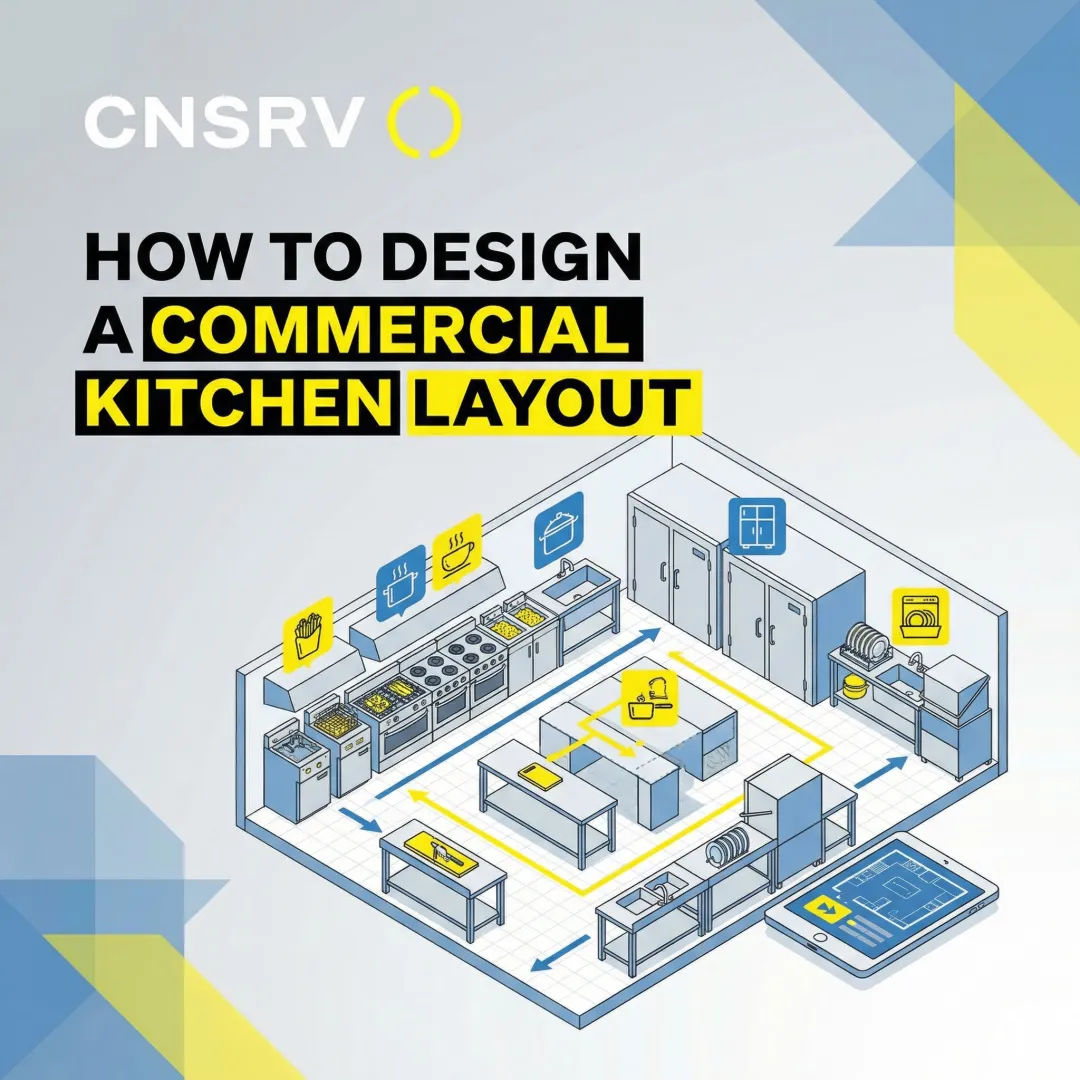
All commercial kitchens are built around one of five core layout models. The right choice depends on your operation's size, menu complexity, and service style — and each layout comes with trade-offs that directly affect throughput, labor costs, and day-to-day profitability.
Assembly Line Layout
The assembly line layout moves food in a linear path from prep to cooking to plating or packaging. This design is best suited for high-volume operations with limited menus, such as fast-food chains, sandwich shops, and catering operations.
Key advantages:
- Maximizes speed and consistency through task specialization
- Minimizes cross-contamination by creating a one-way flow
- Allows staff to master specific stations quickly
- Supports high-volume production with predictable output
Main limitation: Reduced menu flexibility. Complex or customized orders disrupt the linear workflow and slow down the entire line.
Best for: QSR concepts like Chipotle and Subway, fast-casual restaurants with focused menus, and catering operations with standardized offerings.
Zone/Station Layout
The zone layout divides the kitchen into dedicated stations by dish type or function—such as a fry station, sauté station, grill station, or pastry zone. This design works best for large kitchens with diverse menus that require simultaneous preparation of different dish types.
Key advantages:
- Enables staff specialization and expertise development
- Supports flexible menu handling across multiple cuisines
- Allows parallel food production without workflow conflicts
- Accommodates brigade-style kitchen teams effectively
Trade-offs: Higher setup costs due to multiple equipment sets and more square footage required per station. Requires larger staff to operate efficiently.
Best for: Full-service restaurants, hotel kitchens, catering operations, and event venues with complex, multi-course menus.
Galley Layout
Where space is tight, the galley layout earns its keep. Equipment runs along two opposing walls, creating a corridor-style workspace that keeps everything within arm's reach — ideal for food trucks, ghost kitchens, and small cafes.
Key advantages:
- Keeps a full workflow functional in under 500 sq ft
- Creates a natural workflow with everything within arm's reach
- Works well for small teams of 2-4 people
- Reduces equipment costs through compact design
Limitation: Cramped conditions can slow output when teams grow beyond 3-4 people. Staff must coordinate carefully to avoid collisions during busy service.
Ideal for: Food trucks, ghost kitchens averaging 200-300 sq ft, small cafes, and delivery-first operations.
Island Layout
The island layout centers cooking equipment in the middle of the kitchen, with prep and service areas along the perimeter walls. This gives the head chef a clear line of sight across all stations and keeps communication open across the floor.
Key advantages:
- Centralized supervision and quality control
- Open communication between stations
- Easier cleaning and maintenance access
- Supports collaborative kitchen culture
Requirements: Generous square footage (typically 1,000+ sq ft) and good staff coordination to prevent chaotic flow patterns.
Works well for: Large square kitchens, chef-led fine dining concepts, and operations prioritizing visibility and team collaboration.
Open Kitchen Layout
The open kitchen is a guest-facing design where cooking is visible from the dining room, contributing to the ambiance and dining experience. This layout works best for experiential concepts that want to showcase culinary technique as part of the brand.
Key advantages:
- Creates transparency and entertainment value
- Enhances guest engagement and trust
- Allows chefs to interact with diners
- Differentiates the dining experience
Trade-offs:
- Noise, heat, and odor management challenges
- Requires pristine organization and cleanliness at all times
- Increased cross-contamination risk without proper protocols
- Staff must maintain professional appearance and behavior
Best for: High-end experiential dining, chef-driven concepts, and restaurants where the cooking process is part of the brand identity.

Key Zones Every Commercial Kitchen Needs
Regardless of layout type, every commercial kitchen must include five core functional zones. How these zones are arranged relative to each other defines overall workflow quality and operational efficiency.
Food Storage Zone
The storage zone is the starting point for all kitchen operations. According to FDA Food Code requirements, this area must be subdivided into distinct storage types to prevent contamination and maintain food safety.
Required subdivisions:
- Refrigerated storage (35-41°F) for perishables
- Frozen storage (0°F or below) for long-term items
- Dry storage (50-70°F) for non-perishables
- Non-food storage for cleaning supplies, disposables, and dishware
Critical health code rule: Toxic materials must be separated from food by spacing or partitioning and never stored above food items or prep surfaces. Foods must be stored at least 6 inches above the floor to prevent contamination and facilitate cleaning.
Food Preparation Zone
This is where ingredients are washed, cut, portioned, and seasoned before cooking. Position it adjacent to storage for smooth ingredient flow and minimal walking distance.
Best practices:
- High-volume kitchens separate meat prep from produce prep to reduce cross-contamination risk
- Adequate handwashing sinks must be located within convenient reach of all prep areas
- This zone handles thawing and defrosting—a critical water and time consumption point
Traditional running-water defrosting can waste up to 1,000,000 gallons annually per kitchen. Operators can build in efficient, code-compliant defrosting solutions like the CNSRV DC:02, which uses 98% less water than traditional running-faucet methods while defrosting food in half the time, reducing waste and improving throughput at this critical stage.
Cooking Zone
The cooking zone is the highest-intensity zone in any kitchen, housing ranges, ovens, fryers, grills, and other heat-producing equipment. Position it between the prep zone and service area to maintain smooth flow from ingredient to finished dish.
Key considerations:
- Group heat-producing appliances under a single hood system to reduce ventilation costs
- Separate refrigeration from heat sources to prevent compressor overwork
- Ensure adequate ventilation capacity to keep rooms free of excessive heat, steam, and smoke
- Equipment must meet NSF certification standards for food contact surfaces
Service/Plating Zone
This is where finished dishes are plated and handed off to servers or packaged for delivery. Place it at the natural end of the food flow, closest to the dining area or pickup point, to minimize lag time between cooking and service.
Design priorities:
- Adequate counter space for multiple orders during peak service
- Heat lamps or warming equipment to maintain food temperature
- Clear communication system between kitchen and front-of-house staff
- Organized ticket or order display system
Cleaning and Dishwashing Zone
The cleaning zone houses three-compartment sinks, commercial dishwashers, and drying/storage racks. Position it near both the service entrance and storage room so clean equipment cycles back into use quickly.
Placement requirements:
- Accessible to both kitchen staff and front-of-house servers
- Separate from food prep areas to prevent contamination
- Adequate drainage and ventilation
- Space for soiled dish drop-off and clean dish pickup
Dishwashing can account for over two-thirds of kitchen water use. Installing ENERGY STAR certified dishwashers (≤0.89 gallons per rack) and pre-rinse spray valves (≤1.28 gpm) can save over 5,600 gallons annually per unit.

How to Choose the Right Kitchen Layout
Choosing a layout isn't just about aesthetics—it requires evaluating several practical factors that directly affect day-to-day performance and long-term profitability.
Assess Your Available Square Footage
Floor space is the primary constraint that determines which layouts are feasible for your operation.
General sizing guidelines:
- Under 500 sq ft: galley or assembly line layouts maximize efficiency in tight spaces
- 500–1,000 sq ft: galley, assembly line, or zone layouts depending on menu complexity
- 1,000–2,000 sq ft: zone or island layouts support diverse menus and larger teams
- 2,000+ sq ft: zone, island, or open kitchen layouts offer maximum flexibility
Ghost kitchens averaging 200–300 sq ft have very different needs than full-service restaurants averaging 1,000 sq ft or hotel kitchens exceeding 2,000 sq ft.
Match the Layout to Your Menu Complexity
A simple, limited menu is well served by an assembly line or galley layout. A diverse or multi-cuisine menu benefits from a zone layout that allows parallel food production across different stations simultaneously.
Layout by menu type:
- Single cuisine, limited menu → assembly line or galley
- Moderate variety, focused concept → galley or zone
- Diverse menu, multiple cuisines → zone or island
- Complex, chef-driven menu → island or zone
Factor In Staff Size and Roles
Larger teams need layouts with clearly defined, non-overlapping work areas to prevent bottlenecks and collisions during busy service.
Staff size recommendations:
- 1–2 people: a galley layout provides efficiency without wasted space
- 3–5 people: assembly line or galley, depending on menu
- 6–10 people: zone or island layouts support brigade-style teams
- 10+ people: zone layout with specialized stations
Consider Your Service Model
Your service model — how food leaves the kitchen — directly shapes which layout works best.
Service model alignment:
- Dine-in focused: open kitchen or island layout creates a guest-facing experience
- Delivery-only (ghost kitchen): assembly line or galley prioritizes throughput and packaging station access
- Mixed dine-in/delivery: zone layout handles both service models efficiently
- Catering/events: zone layout supports batch production and varied menus
If your model shifts over time — say, adding delivery to a dine-in concept — a zone layout gives you the flexibility to adapt without a full kitchen redesign.

Health Codes and Compliance Considerations
Every commercial kitchen layout must satisfy local and federal health code requirements before opening. Review requirements during the design phase — changes after construction are costly and can delay your opening.
Common Compliance Requirements
- Handwashing sinks must be accessible in all food prep, dispensing, and warewashing areas, supplying water at minimum 85°F with soap and hand drying provisions at each station
- Ventilation and hood systems must eliminate excess heat, steam, and grease vapor; most jurisdictions reference IMC and NFPA 96 for specific engineering and fire safety standards
- Food equipment must carry ANSI-accredited certification (NSF/ANSI 2, 8, or 51) confirming sanitation and food contact safety
- Storage requires foods to be at least 6 inches off the floor, with raw animal proteins separated from ready-to-eat items and toxic materials kept away from all food contact surfaces
Required Permits
Before your kitchen can legally operate, you must obtain:
- Certificate of Occupancy
- Food Service License
- Food Handler's Permits for all staff
Securing these permits requires your layout to already satisfy health department standards. Work with a certified kitchen designer or foodservice consultant early — well before construction or equipment purchasing begins.
Design Tips to Reduce Operational Costs and Improve Efficiency
A well-designed kitchen reduces ongoing operational costs through smart equipment choices, utility planning, and waste reduction built into the layout itself.
Address Water Efficiency Early
A typical medium-sized restaurant uses approximately 2,477 gallons per day, with kitchen and dishwashing activities accounting for 52% of total water use — making water efficiency one of the highest-impact cost levers in your layout plan.
The food prep and thawing zone is one of the largest sources of water waste. Traditional running-water thawing can consume 120-180 gallons per hour, with a single cycle using between 187 and 387 gallons. Planning for water-efficient defrosting solutions at the design stage — such as CNSRV's NSF-listed DC:02 system — can reduce this waste by up to 98%, saving hundreds of thousands of gallons annually per kitchen.
Optimize Equipment Placement
Strategic placement reduces both utility bills and equipment wear:
- Group heat-producing appliances under a single hood system — demand-controlled ventilation (DCKV) cuts exhaust energy by 30-50% compared to constant-speed fans
- Position refrigeration away from heat sources to reduce compressor load, extend equipment life, and lower monthly utility bills
- Spec pre-rinse spray valves at ≤1.28 gpm to save over 7,000 gallons per year per valve
- Choose ENERGY STAR dishwashers to save approximately $300 per year and 5,600 gallons
- Choose ENERGY STAR steam cookers to save approximately $1,000 per year and 162,000 gallons

Calculate Total Cost of Ownership
When selecting equipment for each zone, calculate total cost of ownership (TCO) — not just purchase price. TCO factors in:
- Energy and water costs over the equipment's lifespan
- Routine maintenance and labor
- Disposal or replacement costs
Efficient equipment often carries a higher sticker price, but lower lifetime operating costs and faster payback periods make it the stronger financial choice.
Frequently Asked Questions
What are the five types of commercial kitchen layouts?
The five core layouts are assembly line, zone/station, galley, island, and open kitchen. The best choice depends on your kitchen size, menu complexity, staff size, and service model.
What is the most efficient commercial kitchen layout?
The assembly line layout is generally considered most efficient for high-volume, limited-menu operations like QSR and fast-casual concepts. Zone layouts offer the best efficiency for diverse menus in larger spaces with multiple cooking stations.
How much space do you need for a commercial kitchen?
Space requirements vary by concept. Ghost kitchens can operate in as little as 200 sq ft, while full-service restaurant kitchens typically range from 500 to 2,000+ sq ft depending on menu complexity and staff size.
What are the key zones in a commercial kitchen?
The five core zones are food storage, food preparation, cooking, service/plating, and cleaning/dishwashing. How these zones connect defines workflow efficiency and how smoothly service runs.
How do health codes affect commercial kitchen design?
Health codes cover four key areas that must be built into your layout from the start:
- Handwashing sinks: Required within convenient reach of all prep areas
- Ventilation: Must have adequate capacity to remove heat and steam
- Storage separation: Toxic materials can never be stored above food
- Equipment standards: All units must meet NSF certification requirements
How can I reduce water and operational costs in my commercial kitchen?
Start by auditing your highest-consumption zones — prep and thawing areas are typically the biggest offenders. Swapping in low-flow pre-rinse valves, ENERGY STAR dishwashers, and modern defrosting systems (which use 98% less water and cut thaw time in half versus running-faucet methods) can meaningfully reduce both your water bill and labor overhead.