](https://file-host.link/website/cnsrv-nnegw0/assets/blog-images/41e8d206-d653-420e-89c0-23071dfeb491/1772465624011611_e3d77ff394254f6bbbf19cf17e22179d/360.webp)
Introduction
A commercial kitchen layout is the operational engine of any food service business. A poorly designed kitchen creates bottlenecks, increases labor costs, and slows service — a well-designed one boosts throughput and keeps staff moving efficiently.
The stakes go beyond productivity. 93,800 nonfatal injuries were reported in full-service restaurants in 2019 alone, making layout a direct safety and compliance concern.
Designing a layout may look like a matter of fitting equipment into a room, but the outcome depends heavily on workflow logic, zone planning, and the specific demands of the operation. The FDA Food Code requires plan submittals to include the intended menu and anticipated food volume — meaning equipment and space decisions can't be made in isolation from what you're actually serving.
This guide walks through the exact steps to design a commercial kitchen layout, the core principles that separate functional kitchens from exceptional ones, the most common layout types, and the mistakes that derail even well-funded builds.
TL;DR
- Start by defining your concept, menu, and service volume before touching a floor plan
- Establish a one-directional workflow: each station should hand off to the next with no backtracking
- Six CFSP design principles guide every good layout decision: flexibility, simplicity, flow, sanitation, supervision, and space efficiency
- Layout type (assembly line, zone-based, island) should match your service model, not just square footage
- Common mistakes like ignoring aisle clearances and misplacing warewashing areas are costly to fix after construction
What to Assess Before Designing Your Commercial Kitchen Layout
Skipping the pre-design assessment phase is one of the most expensive mistakes operators make. Decisions about layout directly follow from decisions about cuisine type, service style, team size, and projected cover count. Before drawing a single line, answer these foundational questions:
Operational Parameters
- What is your menu complexity and production volume?
- How many covers per day do you anticipate?
- What is your service style (QSR, fast casual, full-service, fine dining)?
- How large is your kitchen team, and how many stations will operate simultaneously?
Menu-Driven Equipment Needs
The FDA Food Code requires operators to submit the "intended menu" and "anticipated volume of food" — confirming that equipment and space allocation can't be determined without these inputs. A high-volume burger concept serving 2,000+ covers daily needs very different equipment and spatial logic than a fine dining kitchen with multiple cooking stations. Scratch cooking also requires significantly more prep space and storage than operations using pre-prepared ingredients. Industry guidance from FCSI confirms that menu complexity directly shapes zone sizing and equipment selection.
These operational realities also determine your regulatory exposure — what you cook, and how much of it, affects the codes you'll need to satisfy.
Regulatory and Space Constraints
Identify these constraints upfront to avoid costly redesigns:
- Local health department requirements and inspection standards
- Fire codes and NFPA 96 ventilation standards
- ADA compliance standards for accessible design
- Physical dimensions including ceiling height and load-bearing walls
- Existing utility connections (gas, water, electrical)
- Ventilation access points and make-up air capacity
How to Design a Commercial Kitchen Layout: Step-by-Step
Step 1: Define Your Workflow Zones
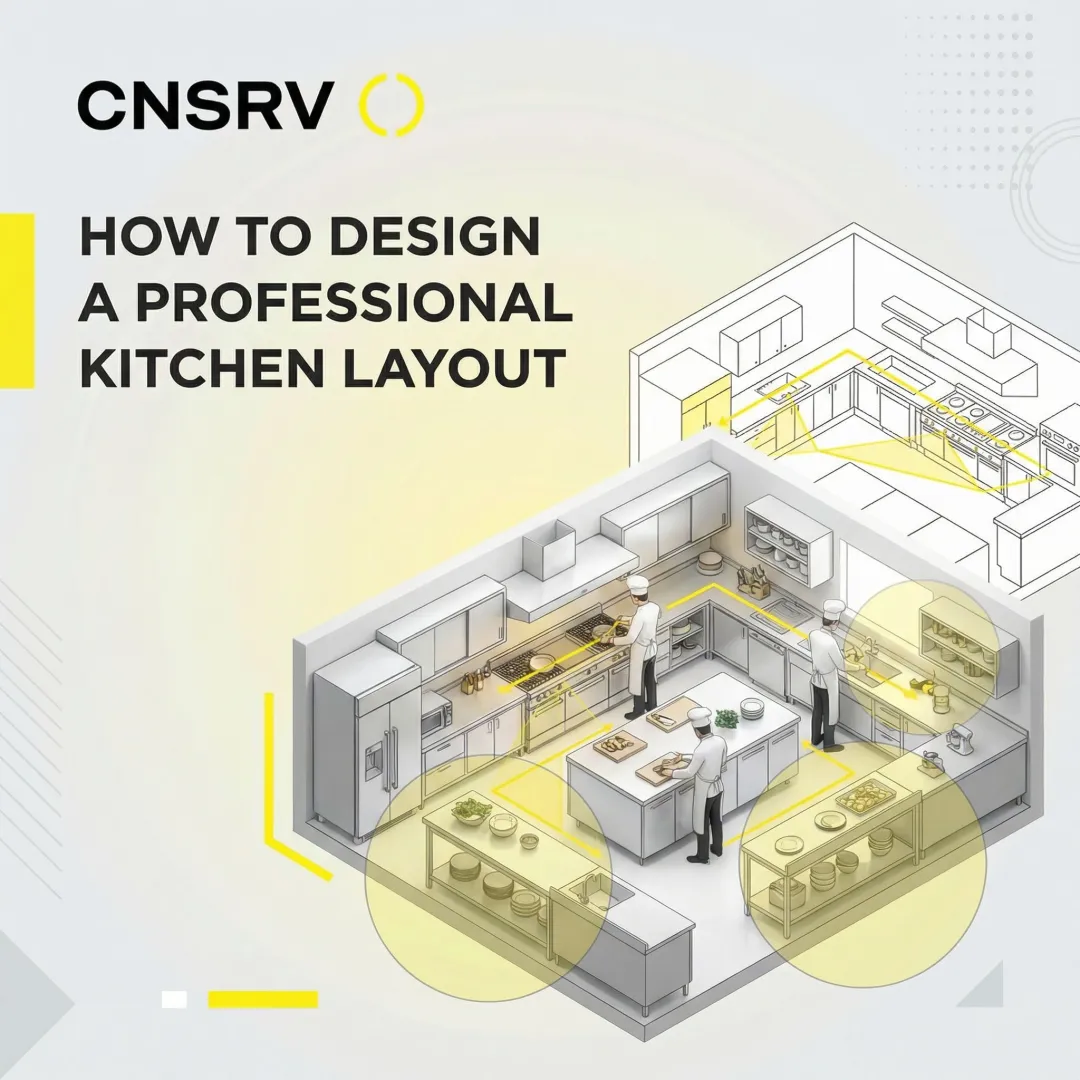
Every commercial kitchen is built around functional zones that food must pass through in a logical sequence: receiving, dry/cold storage, food prep, cooking line, plating/expo, warewashing, and waste disposal. Defining these zones before placing any equipment is the foundation of the entire layout.
The FDA Food Code mandates that plan submittals demonstrate proper workflow to prevent cross-contamination. Keep raw food prep physically separated from cooked food plating zones. The flow of clean dishes, dirty dishes, food, and staff should never cross paths within the layout.
From there, establish a single directional path for food — from delivery to the pass — with a corresponding return route for dirty dishes to the warewashing area. One-directional workflow eliminates backtracking and minimizes cross-traffic during peak service.

Step 2: Map Equipment to Each Zone
Once zones are defined, populate each zone with the specific equipment required to support it. Start with the largest, most utility-intensive pieces — ranges, hood systems, walk-in coolers, dishwashers — and work down to smaller countertop units. Equipment placement should follow the zone's function, not available floor space.
Thawing and defrosting workflows deserve particular attention in the prep zone. Operators relying on running water for defrosting waste approximately 114,000 gallons of water per year per kitchen and introduce unnecessary wet zones into the layout.
The CNSRV DC:02 defrosting system eliminates that problem — zero installation required, fits standard 18-inch prep sinks and larger, and reduces water usage by 98% compared to running-faucet methods. It drops into the prep zone without adding plumbing or disrupting flow.
Equipment in every zone should follow a clear hierarchy:
- Primary: Walk-in coolers/freezers, cooking suite, commercial dishwashers
- Secondary: Prep tables, refrigerated prep stations, worktables
- Tertiary: Shelving, smallwares storage, mobile carts
Step 3: Plan Utility Connections and Ventilation
Positioning equipment without considering utility infrastructure leads to costly retrofits. Gas lines, floor drains, electrical panels, and water connections must be mapped early. Utility-intensive equipment should be clustered near existing connections wherever possible.
The cooking line must sit under or near commercial hood exhaust systems to meet fire code. NFPA 96 (2024) mandates that kitchen negative pressure must not exceed 0.02 inches water column — a ventilation balance that gets missed in early design more often than it should.
Beyond ventilation, several utility requirements have fixed placement implications:
- Make-up air systems must operate simultaneously with exhaust systems
- Grease trap access must be easily reachable for cleaning (FDA §5-402.12)
- Hand-washing sinks must be within functional reach of food prep and cooking areas
- Floor drains must be positioned to handle equipment discharge and cleaning runoff
Step 4: Validate Against Code, Clearances, and Flow
Before finalizing the layout, review it against local health department requirements and fire codes. This includes minimum aisle widths, equipment spacing from combustibles, and proper placement of fire suppression systems above the cooking line.
There's a critical distinction between "code minimum" for safety and "functional minimum" for workflow:
- Single cook: 42 inches minimum work aisle
- Multiple cooks: 48 inches to allow staff to pass safely
- Code minimum (egress): 36 inches for areas with ≤50 seats, 44 inches for >50 seats

Once aisle widths are confirmed, do a walk test. Trace the path each staff member, ingredient, and piece of equipment would take during a real service. This final check catches flow problems, blind spots, and bottlenecks before any equipment is purchased or construction begins.
Core Design Principles for an Efficient Commercial Kitchen
The Certified Food Service Professionals (CFSP) program outlines six design principles for evaluating and stress-testing any commercial kitchen layout.
Flexibility and Modularity
A kitchen designed with flexibility—through mobile prep tables, rolling equipment, and modular shelving—allows operators to adapt to seasonal menu changes, staff configurations, and future growth without a full rebuild. This is especially valuable for multi-concept operators or kitchens anticipating menu evolution.
Simplicity
Needs-only design means every piece of equipment, shelf, and surface should justify its footprint by directly supporting the menu and service model. Cluttered or over-equipped kitchens increase movement time, complicate cleaning, and contribute to staff fatigue.
Flow of Materials and Personnel
The layout should create a single, logical directional path for food from delivery to the pass, with a corresponding return path for dirty dishes to the warewashing area. Staff movements should be intuitive, and cross-traffic during peak service minimized.
That movement pattern also has direct safety implications. Food preparation workers experience injury rates three times higher than the private industry average, and ergonomic design is a primary lever for reducing that risk. OSHA notes that proper ergonomics "lessens muscle fatigue, increases productivity, and reduces the number and severity of work-related MSDs."
Ease of Sanitation
Every material and equipment placement decision should account for how the kitchen will be cleaned. Common problem areas include:
- Equipment too heavy or fixed to move for cleaning
- Gaps between walls and equipment where debris collects
- Hard-to-reach corners that go unchecked between inspections
Stainless steel surfaces, coved flooring, and sealed wall panels are standard choices because they eliminate those problem areas at the source.
Space Efficiency and Supervision
Maximizing vertical storage, avoiding oversized equipment, and maintaining open sightlines across the kitchen serve two goals at once: using every square foot productively and allowing supervisors or expeditors to monitor all stations without blind spots. Both outcomes — operational efficiency and quality control — depend on the same spatial decisions.

Common Commercial Kitchen Layout Types
Assembly Line / Linear Layout
The assembly line layout positions stations sequentially along one or two parallel lines, moving food from prep to cooking to plating in a straight path. This setup works best for high-volume, limited-menu operations like fast casual, QSR, and school cafeterias where consistency and throughput are the primary goals.
It's extremely efficient for standardized menus — but if your menu requires multiple cooking methods running simultaneously, this layout will show its limits quickly.
Zone/Station Layout
The zone layout divides the kitchen into discrete cooking stations — grill, sauté, fry, pastry — each with its own equipment and dedicated workflow. This approach suits full-service restaurants with diverse menus where different dishes are prepared simultaneously and sous chefs manage individual stations.
The upside is real menu flexibility and the ability to develop specialized skills per station. The downside: you'll need more square footage, and service coordination becomes critical — traffic conflicts between stations can derail a busy night.
Island Layout
The island layout places primary cooking equipment (ranges, grills, ovens) in a central island, with prep and storage running along the perimeter. This creates a circular workflow that supports mid-to-large kitchens with sufficient square footage and open supervision needs.
Chef communication and supervision improve noticeably with this configuration. That said, it demands minimum kitchen dimensions — cramped clearance around the island becomes a safety and efficiency problem fast. Skip this one for small or narrow spaces.
Quick comparison: which layout fits your operation?
| Layout | Best For | Main Limitation |
|---|---|---|
| Assembly Line | High-volume, limited menus (QSR, cafeterias) | Inflexible for varied menus |
| Zone/Station | Full-service restaurants, diverse menus | Requires space and coordination |
| Island | Mid-to-large kitchens needing open supervision | Not viable for small/narrow spaces |

Common Mistakes When Designing a Commercial Kitchen Layout
Underestimating Aisle Width and Traffic Flow
Cramped aisles between cooking equipment, prep tables, and refrigeration units are one of the most common and costly layout errors. Industry guidelines recommend 42 inches for single-cook aisles and 48 inches for multiple-cook traffic, yet many operators default to the 36-inch code minimum for egress.
Inadequate clearance creates safety hazards and slows service during peak hours. Measure aisle widths with equipment installed, accounting for open oven doors and refrigerator access, to prevent bottlenecks.
Misplacing the Warewashing Area
Placing the dishwashing station too close to the cooking line or food prep area introduces noise, steam, moisture, and cross-contamination risk. The warewash station should sit at the back or perimeter of the kitchen, with a clear path for bussed dishes that does not cross the cooking or plating zones.
Neglecting Ventilation Planning Until After Equipment Is Placed
Commercial hood systems must be positioned directly above all heat-producing cooking equipment. Retrofitting ventilation after equipment is placed frequently requires relocating major appliances or cutting into ceilings — an expensive, disruptive correction.
Plan ventilation in the first pass of your layout. This means calculating make-up air requirements and confirming grease trap access meets local health code and NFPA 96 standards for cleaning and inspection.
Designing for Current Menu Only
Kitchens built with zero flexibility to accommodate menu evolution or volume increases force costly redesigns within years of opening. Build in modular or multi-use capacity where budget allows — particularly in these areas:
- Prep zones: Use mobile prep tables that can be repositioned as menu needs shift
- Storage: Install shelving systems that can be reconfigured rather than fixed cabinetry
- Utility connections: Rough in additional gas and electrical drops during initial construction
Frequently Asked Questions
What is the best layout for kitchen items?
The best layout for kitchen items follows the workflow logic of the operation. Items should be stored, staged, and positioned in the sequence they are used — from receiving through prep and cooking to service. This minimizes unnecessary movement and keeps frequently used items within arm's reach of each station.
What are the 5 key kitchen appliances that need design consideration?
The five equipment categories that most significantly impact layout planning are:
- Commercial hood/ventilation systems — determine cooking line placement
- Walk-in coolers and freezers — dictate storage zone footprint
- Commercial dishwashers — define the warewash area
- Cooking suite/range/oven combinations — anchor the hot line
- Refrigerated prep tables and food prep equipment — establish prep zone boundaries
How much space do you need for a commercial kitchen?
There is no universal minimum, but industry guidance typically suggests allocating roughly 5 square feet of kitchen space per dining seat for full-service restaurants. FCSI recommends allocating 25% to 35% of total facility space to the kitchen, though space needs vary significantly by concept, volume, and menu complexity.
What are the key zones in a commercial kitchen layout?
The core functional zones are:
- Receiving
- Dry and cold storage
- Food preparation
- Cooking line
- Plating and expo
- Warewashing
- Waste and disposal
Keeping these zones clearly separated prevents cross-contamination and establishes directional workflow, as required under FDA Food Code plan review standards.
How do I ensure my commercial kitchen layout meets health code requirements?
Start by consulting your local health department and fire marshal before finalizing any plans. Then work with a certified foodservice equipment consultant familiar with local codes to verify that your layout meets minimum clearances, hand-sink placement, ventilation standards, and material requirements before permit submission.
What is the most efficient commercial kitchen layout for a small restaurant?
For small footprints, the galley (corridor) or assembly line layout delivers the best efficiency. These linear configurations minimize wasted movement, maximize wall-mounted and vertical storage, and allow a small team to cover multiple stations without excessive cross-traffic.