Introduction
Commercial kitchens operate under constant food safety scrutiny. Equipment choices — not just training or protocols — determine whether a kitchen stays compliant or faces costly violations.
Foodborne illness costs the U.S. economy $74.7 billion annually (2023 USD), and individual restaurant outbreaks run $4,000 to $2.6 million depending on scale and pathogen. CDC data consistently traces these outbreaks to preventable equipment failures: inadequate temperature control, cross-contamination, and unsafe thawing.
This guide covers the essential food safety equipment every commercial kitchen needs — from temperature control and cross-contamination prevention to safe thawing, sanitation, and fire safety — including which certifications matter and why.
Why Food Safety Equipment Is Non-Negotiable
Commercial kitchens must meet local health department codes, FDA Food Code guidelines, and often HACCP (Hazard Analysis and Critical Control Points) standards. Equipment isn't just a convenience—it's a core compliance requirement.
The regulatory landscape is complex: as of 2025, 24 states have adopted either the 2017 or 2022 FDA Food Code editions, with local health departments enforcing standards through risk-based inspections. Violations trigger immediate consequences—equipment "tagging," temporary closures, or worse.
The Real Costs of Inadequate Equipment
Operational risks include:
- Failed health inspections and temporary closures
- Reputational damage that drives customers away
- Legal liability from customer illness
- Direct financial losses from outbreak response
A single outbreak can cost anywhere from $4,000 to $2.6 million. Compliant refrigeration, thermometers, and sanitization equipment represent a fraction of that exposure.
The Certification That Matters
Equipment alone isn't enough—it must be NSF-listed or certified for food contact to be both legally defensible and safe. The FDA Food Code states that equipment certified to ANSI-accredited standards (like NSF) is deemed compliant with sanitation provisions. Health departments and insurance providers routinely require NSF certification, so treat it as your first filter when evaluating any purchase.
Temperature Control: Cold Storage and Refrigeration Equipment
Understanding the Temperature Danger Zone
The FDA defines the Temperature Danger Zone as 41°F to 135°F (5°C to 57°C)—the range where bacteria multiply rapidly. Maintaining proper cold and hot holding temperatures is the foundation of commercial food safety.
Critical temperature requirements:
- Cold holding: TCS (Time/Temperature Control for Safety) food must stay at 41°F or below
- Hot holding: Food must be maintained at 135°F or above
- Reheating: Food reheated for hot holding must reach 165°F for 15 seconds
Where Kitchens Fail
CDC analysis of outbreaks from 2014-2022 reveals specific temperature-related failures:
- 13.1% of outbreaks: Food left out of temp control during preparation
- 11.5%: Food left out of temp control during service/display
- 10.2%: Inadequate cold holding practices
- 10.1%: Inadequate hot holding practices
- 5.6%: Malfunctioning refrigeration equipment

Walk-In Coolers and Freezers
What to look for:
- Precise thermostat control with digital displays
- Reliable door seals that prevent temperature fluctuations
- Interior temperature logging capabilities
- NSF/ANSI 7 certification for commercial refrigeration
Raw proteins and perishables leave no margin for error. When refrigeration fails during busy service, entire inventories can enter the danger zone within hours.
Prep Table Refrigerators
These units keep ingredients at safe temperatures during active prep, reducing the window for bacterial growth and maintaining safety from delivery to plate. Look for models with:
- Built-in thermometers accurate to ±2°F
- Easy-to-clean stainless steel surfaces
- NSF/ANSI 7 compliance
Thermometers and Hot-Holding Equipment
Calibrated digital thermometers are essential for:
- Verifying internal cooking temperatures
- Checking holding equipment accuracy
- Documenting compliance during inspections
FDA standards require food thermometers to be accurate to ±2°F (±1°C), while ambient air thermometers in holding units must be accurate to ±3°F (±1.5°C). Spot-checking every two hours during service is a practical baseline for most commercial kitchens.
Steam tables and food warmers must maintain food above 135°F throughout service — not just at the start of a shift. Malfunctioning hot-holding equipment contributed to 1.5% of outbreaks in CDC data; a daily calibration check before service is the simplest way to catch equipment drift before it becomes a health code violation.
Cross-Contamination Prevention: Essential Equipment for Safe Food Prep
Defining the Risk
Cross-contamination—pathogen transfer between raw and ready-to-eat foods, between surfaces, and via hands—is a leading cause of foodborne illness in food service. The FDA Food Code mandates physical separation of raw animal foods from RTE foods during storage, preparation, and display.
Color-Coded Cutting Boards
The industry-standard color system (endorsed by ServSafe and widely used in HACCP plans):
| Color | Food Category |
|---|---|
| Red | Raw Meat |
| Yellow | Raw Poultry |
| Blue | Raw Seafood |
| Green | Produce (Fruits/Vegetables) |
| Brown | Cooked Meats |
| White | Dairy/Bakery |

Visual protocols dramatically reduce staff error during high-volume prep. When purchasing, look for:
- NSF/ANSI 51-approved materials
- Dishwasher-safe construction
- Commercial-grade durability (non-porous, smooth surfaces)
Dedicated Prep Surfaces and Containers
Separate, labeled storage containers and prep zones for different protein categories are essential in busy kitchens. Equipment layout choices can structurally prevent cross-contamination—dedicated zones for raw proteins, produce prep, and ready-to-eat assembly.
NSF/ANSI 2 certification covers the sanitary design of food handling equipment — tables, counters, and sinks — requiring smooth, durable, nonabsorbent surfaces that are easy to clean and maintain.
Handwashing and Glove Stations
FDA Food Code requirements:
- Handwashing sinks must be "conveniently located" in food prep, dispensing, and warewashing areas
- Sinks must be accessible at all times and used only for handwashing
- Hot water temperature: at least 85°F (29.4°C) per 2022 FDA Food Code
- Splash guards required if sinks are near food or food-contact surfaces
- Stock stations with food-safe disposable gloves and cut-resistant gloves for protein handling
Knife Storage and Blade Safety
Glove discipline and hand hygiene matter less if knives are stored unsafely. Proper blade storage prevents both staff injuries and unsanitary contact with food surfaces:
- Knife sheaths for individual blade protection
- Magnetic strips for visible, accessible storage
- Dedicated knife blocks by prep station
Keeping blades covered and station-assigned reduces the risk of cross-contact between raw protein zones and RTE prep areas.
Safe Thawing Equipment: The Overlooked Food Safety Essential
Why Improper Thawing Is Dangerous
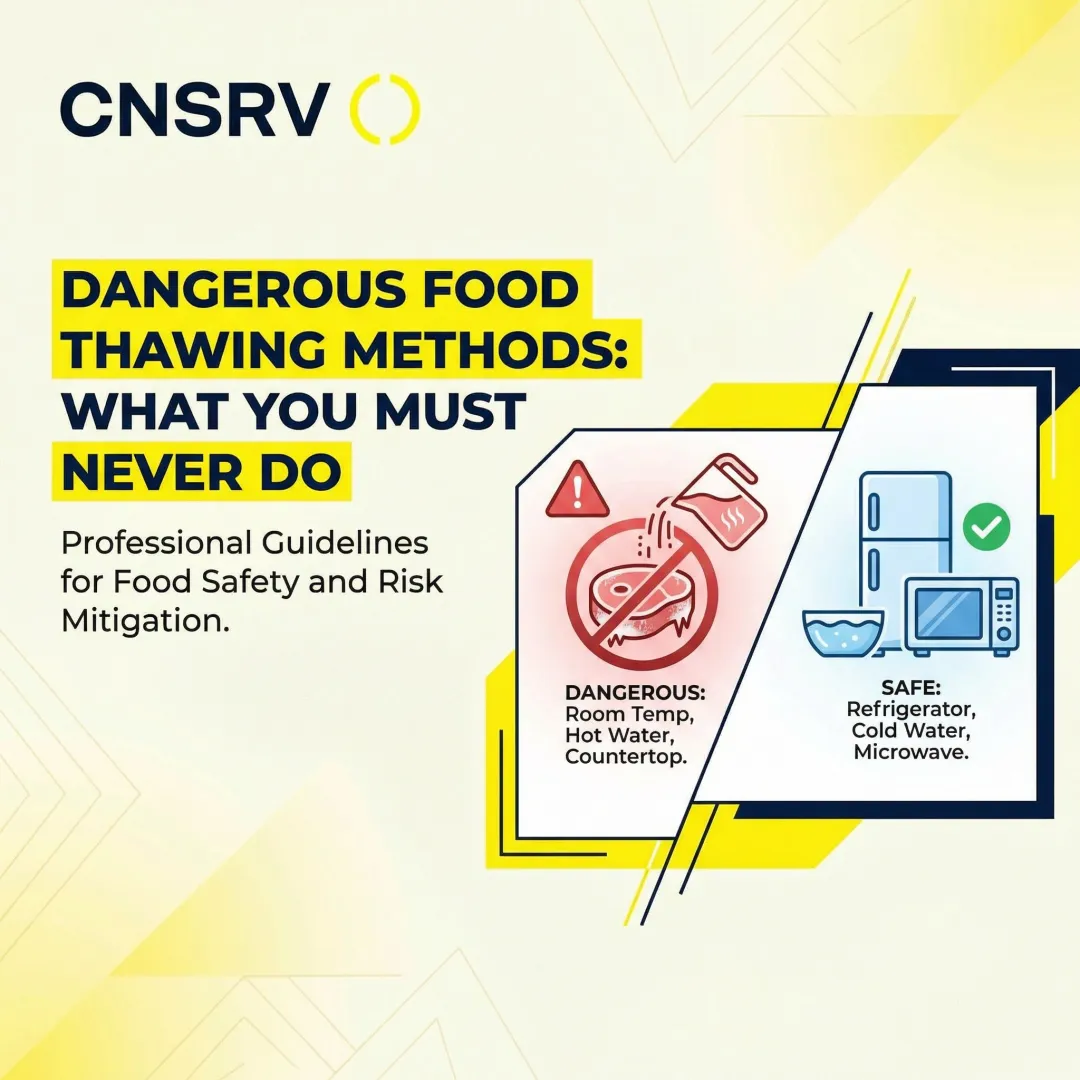
Improper thawing is one of the most overlooked food safety risks in commercial kitchens. Thawing food at room temperature or under uncontrolled conditions allows outer layers to enter the temperature danger zone while the core remains frozen — creating conditions for rapid bacterial growth.
CDC data shows that inadequate or insufficient thawing contributed to 32% of restaurant-associated outbreaks where contributing factors were identified.
The Running-Faucet Problem
Traditional running-faucet thawing has two core problems:
- Compliance exposure: Municipal tap water during warmer months regularly measures 75-85°F in many regions — well above the FDA's 70°F maximum for running-water thawing. Without controlled temperature and flow rate, every thaw cycle is a potential violation.
- Water waste: Commercial kitchen faucets operate at 2.2 gallons per minute or higher, sending thousands of gallons down the drain daily with no recovery.
Purpose-Built Commercial Defrosting Systems
Purpose-built defrosting systems replace the open-faucet approach with a closed-loop process: controlled water agitation, digital temperature monitoring, and documented compliance — all in one unit.
CNSRV's DC:02 defrosting system delivers on all three fronts:
- NSF-listed for food contact (NSF Standard 169)
- Uses 98% less water than traditional running-faucet methods (up to 1,000,000 gallons saved annually per kitchen)
- Defrosts food in roughly half the time of faucet thawing
- Maintains water below 70°F through digital sensors and software-controlled temperature regulation
- Circulates water at 130 gallons per minute—10-30× faster than typical commercial faucets
The system requires zero installation—it ships directly to your door, operates in 18-inch prep sinks or larger, and needs no plumbing connections or professional setup.
FDA-Approved Thawing Methods
The FDA Food Code Section 3-501.13 mandates four approved methods:
- Refrigeration: Maintain food at 41°F or below
- Running Water: Completely submerged under running water at 70°F or below, with sufficient velocity to agitate and float off particles (total time above 41°F cannot exceed 4 hours for raw animal foods)
- Cooking: Thawed as part of continuous cooking
- Microwave: Only if cooked immediately afterward
Refrigerator thawing satisfies the code but can't keep pace with high-volume service. Running water is fast — but only when temperature and flow are actively controlled. That's where most kitchens fall short.
The Compliance Angle
Health departments and HACCP plans increasingly scrutinize thawing procedures. Using a documented, controlled defrosting process protects operators during inspections and audits. The DC:02 was independently verified by Dr. Eric Schulze, PhD, a former FDA food-safety regulator, who confirmed compliance with FDA Food Code § 3-501.13 and California Retail Food Code § 114020.
Sanitation, Personal Protective Equipment, and Fire Safety
Sanitation Stations and Commercial Dishwashers
NSF/ANSI 3 certification covers commercial warewashing equipment, ensuring dishwashers reach proper sanitizing temperatures:
- Hot water sanitization: Surface temperatures must reach 160°F to 180°F depending on machine type
- Chemical sanitization: Concentrations (chlorine, iodine, quats) must be verified using test kits per FDA Food Code 4-501.116
Three-compartment sinks serve as the regulatory baseline for manual utensil cleaning. FDA Food Code 4-301.12 requires sinks with at least three compartments (wash, rinse, sanitize) large enough to accommodate the largest equipment and utensils.
Personal Protective Equipment
Essential PPE includes:
- Oven mitts and heat-resistant arm guards
- Non-slip floor mats
- Cut-resistant gloves
- Food-safe aprons
Proper PPE reduces injury risk, keeps staff on the floor, and reinforces a kitchen-wide culture of safety.
Fire Suppression and Extinguisher Access
Fire risk is one of the most serious hazards in commercial kitchens. Cooking equipment caused 61% of structure fires in eating and drinking establishments between 2010 and 2014, resulting in $165 million in direct property damage annually (NFPA).
NFPA 10 requirements:
- Class K fire extinguishers for combustible cooking media (vegetable or animal oils/fats)
- Maximum travel distance to extinguisher: 30 feet
- Placard near extinguisher stating that automatic hood suppression must be activated prior to using portable extinguisher

Extinguishers must be inspected monthly and after any use — placement and visibility are as important as the equipment itself.
How to Choose Food Safety Equipment: Key Buying Criteria
NSF Certification and Food Safety Listings
NSF certification is the most important filter when evaluating food safety equipment. NSF-listed equipment has been independently tested against food safety and sanitation standards—health departments and insurance providers often require it for any food-contact surfaces.
Key NSF/ANSI standards for commercial kitchens:
| Standard | Scope | Typical Equipment |
|---|---|---|
| NSF/ANSI 2 | Food Equipment | Tables, counters, sinks, hoods |
| NSF/ANSI 3 | Commercial Warewashing | Dishwashers, glasswashers |
| NSF/ANSI 7 | Commercial Refrigerators/Freezers | Reach-ins, walk-ins, prep tables |
| NSF/ANSI 18 | Manual Dispensing Equipment | Beverage dispensers |
| NSF/ANSI 51 | Food Equipment Materials | Cutting boards, gaskets, tubing |

Cleanability and Material
Food safety equipment should be made from non-porous, smooth surfaces that can be fully sanitized without harboring bacteria in cracks, joints, or textured surfaces.
Preferred materials:
- Stainless steel — 304 grade is standard for most commercial kitchens; 316 grade for food processing environments
- Food-grade plastics — must meet NSF/ANSI 51 approval for food-contact use
- Anodized aluminum — suitable for select non-contact or low-moisture applications
Equipment must be easily disassembled for thorough cleaning and sanitization—a core NSF requirement.
Compliance with Local Codes and Rebate Eligibility
Before purchasing, verify equipment meets your state and local health codes and check whether energy- or water-efficient models qualify for utility rebates. Several active programs offer meaningful savings:
Active rebate programs include:
- Metropolitan Water District (Southern California): $800 per CNSRV DC:02 unit
- Tampa Bay Water (Florida): Custom rebate program for commercial kitchens
- Portland Water Bureau (Oregon): Customizable incentive program
Rebate-eligible equipment like the CNSRV DC:02 can offset upfront costs—in some cases, the monthly savings on water bills exceed the monthly cost of the unit.
Frequently Asked Questions
What equipment is legally required for food safety in a commercial kitchen?
Core categories include refrigeration (NSF/ANSI 7), handwashing stations with hot water (≥85°F), calibrated food thermometers (±2°F accuracy), and sanitizing equipment (NSF/ANSI 3 dishwashers or three-compartment sinks). Specific requirements vary by jurisdiction—verify with your local health department.
What does NSF-listed mean for food safety equipment?
NSF International independently tests and certifies equipment to meet public health and food safety standards. Certification covers material safety, cleanability, performance, and durability. The FDA Food Code deems NSF-certified equipment compliant with sanitation provisions, making it the legal baseline for commercial kitchens.
What is the safest way to thaw frozen food in a commercial kitchen?
FDA-approved methods include refrigerator thawing (≤41°F), controlled defrosting systems with water ≤70°F and proper agitation, microwave thawing for immediate cooking, and cooking from frozen. Room-temperature thawing and uncontrolled faucet thawing are not compliant methods.
What temperature range is considered dangerous for food storage?
The FDA defines the Temperature Danger Zone as 41°F to 135°F (5°C to 57°C). Bacteria multiply rapidly in this range. TCS food must be stored below 41°F or held above 135°F, and should not remain in the danger zone for extended periods (typically no more than 4 hours cumulative).
How often should commercial kitchen food safety equipment be cleaned and inspected?
All food-contact surfaces require daily cleaning, and dishwashers need daily sanitizer concentration checks. Thermometers should be calibrated monthly or per manufacturer specs. HACCP plans define deeper cleaning intervals—weekly, monthly, or quarterly—based on equipment type and usage.
How can kitchen equipment help prevent cross-contamination?
Color-coded cutting boards and dedicated prep surfaces keep raw proteins physically separated from produce and ready-to-eat items. NSF/ANSI 2-certified equipment with smooth, nonabsorbent surfaces leaves no bacterial harboring points. Strategically placed handwashing sinks and glove stations reinforce hygiene at every step.