Introduction
For commercial kitchens and restaurants, food waste is a direct hit to the bottom line. ReFED estimates that 4.2% of food purchases are never used — translating to billions in lost revenue each year. In the US alone, foodservice operations produced 12.5 million tons of surplus food in 2024, with nearly 70% driven by plate waste.
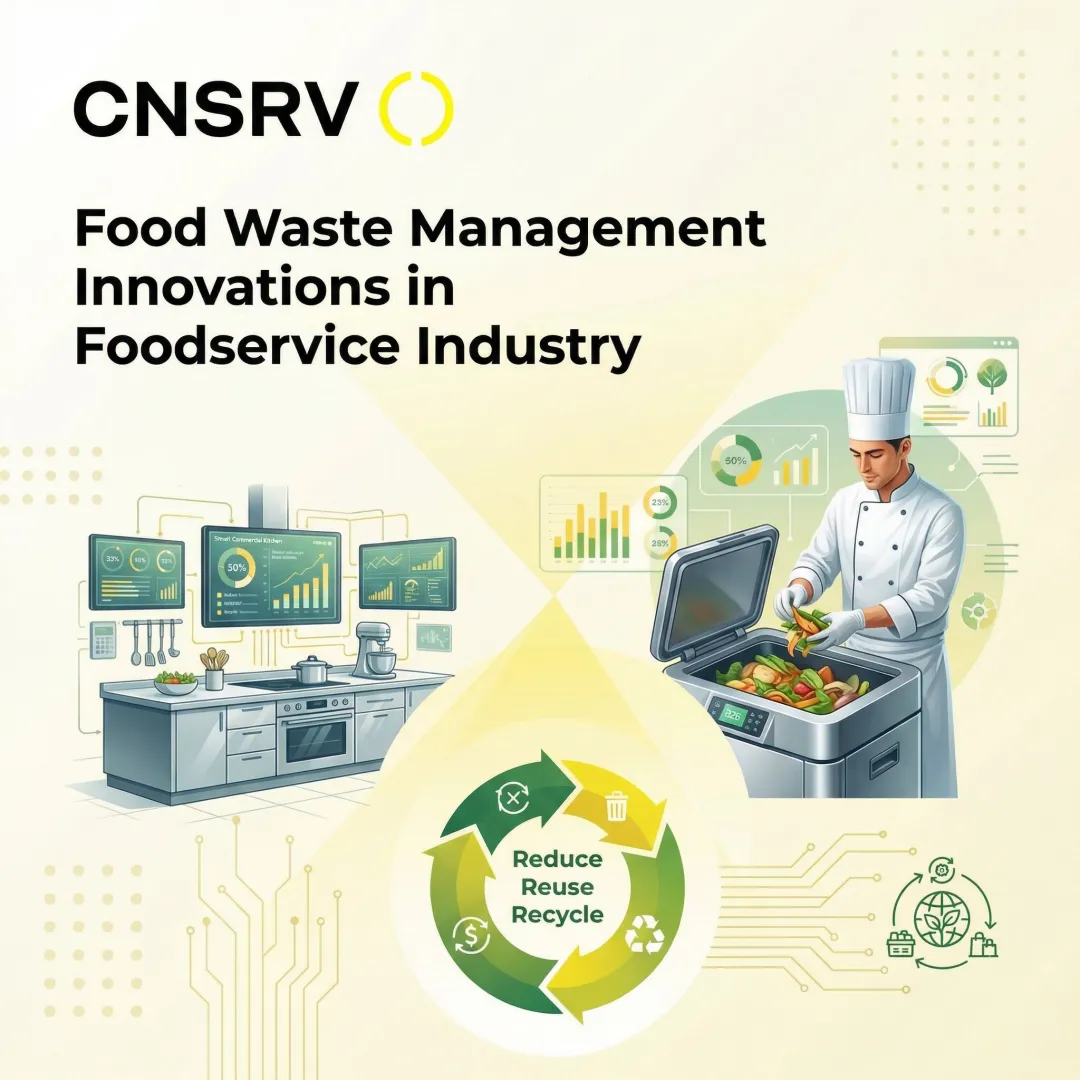
Food waste management software now gives commercial kitchens, food distributors, and multi-unit operators a way to fight back. These platforms track and analyze waste across purchasing, prep, and service — helping operators cut costs, meet sustainability targets, and understand exactly where food dollars disappear.
This article covers the top five food waste management software solutions, what features matter most, and how to choose the right one for your operation.
TL;DR
- Food waste software tracks and reduces waste across purchasing, prep, and service stages
- Leading tools cover AI kitchen monitoring, surplus redistribution, supply chain compliance, and audit-based tracking
- Prioritize real-time tracking, analytics dashboards, POS/ERP integrations, and multi-site scalability
- Match the software to your specific waste problem—not just your budget
- No software works without staff buy-in and operational follow-through
What is Food Waste Management Software?
Food waste management software is a digital platform that helps food businesses monitor, record, categorize, and reduce the volume of food discarded at any stage of operations—from receiving and storage to prep and service.
These platforms address two core problem areas:
- Pre-consumer waste — spoilage, overproduction, and prep trimmings that occur before food reaches the customer
- Post-consumer waste — plate waste and buffet surplus left by diners
Tracking each separately is essential because the corrective actions differ. Pre-consumer waste typically signals purchasing or inventory problems, while post-consumer waste points to portion sizing or menu design issues.
That operational urgency is reshaping the market. The global food waste management market was valued at $69.8 billion in 2022 and is projected to reach $106.7 billion by 2030, growing at a CAGR of 5.4%. The commercial segment—hotels, restaurants, cafes—is expected to grow even faster at 6.0% annually, as foodservice operators shift from treating waste tracking as a nice-to-have to building it into standard operations.

Top 5 Food Waste Management Software Solutions
We selected these five platforms based on market presence, core functionality, verified user outcomes, and suitability across different foodservice contexts—from single kitchens to enterprise chains.
Winnow
Winnow is an AI-powered food waste platform designed for high-volume commercial kitchens including hotels, contract catering, cruise lines, and casinos. Its Vision AI system uses computer vision and smart scales to auto-identify and weigh discarded food.
The Vision AI identifies waste items automatically, so kitchen staff don't need to manually log each item. Results from real deployments include:
- Guckenheimer: 64% waste reduction, saving ~$1 million annually
- London Marriott Hotel Canary Wharf: 67% waste reduction in six months
- IKEA: over $37 million saved globally
| Best For | High-volume commercial kitchens, hotels, contract caterers, cruise lines || Key Features | AI computer vision waste identification, smart scale integration, real-time dashboards, CO₂ impact reporting || Pricing Model | Enterprise-quoted subscription; pricing varies by kitchen size (Small <$100k annual food costs to Large $500k+); hardware and SaaS bundled |
LeanPath
LeanPath is a foodservice-focused food waste tracking and analytics platform widely adopted in corporate dining, university campuses, healthcare foodservice, and restaurant groups. It uses AI-enabled food recognition at the point of disposal.
LeanPath combines smart scale stations with software to capture waste data at the point of disposal with minimal staff effort. It covers both prep waste and plate waste, and includes donation logging—making it one of the more complete foodservice-specific options available.
Reported outcomes include a 50% average food waste reduction and a 2–6% drop in food purchase costs. The Sheraton Grand Hotel & Spa Edinburgh cut waste value by 64% and waste weight by 58% in just over a year.
| Best For | Corporate dining, university campuses, healthcare foodservice, restaurant groups || Key Features | AI food recognition, prep and plate waste tracking, donation logging, coaching tools, multi-site reporting || Pricing Model | Enterprise-quoted; complete solution includes hardware, software, and coaching; hardware may be bundled or separate |
Spoiler Alert
Spoiler Alert is a platform built for food manufacturers, distributors, and large retail foodservice operators to manage surplus inventory, automate discounting or donation workflows, and track waste analytics across the supply chain.
Unlike kitchen-focused tools, Spoiler Alert operates upstream—helping businesses redirect surplus before it becomes waste by connecting sellers with buyers or donation channels. Land O'Lakes donated over 3.6 million pounds of product in 2023 through the platform (a five-fold increase over prior years), saving nearly $200,000 in landfill fees. Clients typically see 50% growth in discount revenue and 65% faster speed to market.
| Best For | Food manufacturers, distributors, grocery retail, large foodservice chains managing surplus inventory || Key Features | Surplus inventory management, automated discount/donation workflows, waste analytics, buyer network integration || Pricing Model | Enterprise/custom-quoted; requires demo scheduling for pricing |
FoodLogiQ (Trustwell)
FoodLogiQ, now part of Trustwell, is a food traceability and compliance platform used by food producers, processors, and distributors to track ingredients across the supply chain and identify waste-generating points tied to recalls, spoilage, or compliance failures.
Its core strength is upstream traceability rather than kitchen-level tracking. FoodLogiQ helps businesses pinpoint which ingredients are driving waste due to quality issues or supply chain inefficiencies—critical for FSMA compliance and recall readiness. Wawa onboarded 90% of suppliers within three months; First Watch reported faster recall response times and stronger food safety management overall.
| Best For | Food producers, processors, distributors, and enterprises requiring supply chain compliance and traceability || Key Features | Ingredient traceability, supplier compliance management, recall readiness, waste-linked quality event tracking || Pricing Model | Enterprise SaaS; custom-quoted (some consulting services listed at flat fees, e.g., FSMA in Focus at $4,999) |
GoAudits
GoAudits is a mobile-first audit and inspection platform used across food and hospitality sectors to digitize food safety and waste tracking checklists, conduct real-time waste audits, and generate instant compliance reports. It's well-suited for multi-site restaurant groups and food businesses already running regular inspections.
GoAudits integrates food waste tracking within a broader food safety and operational compliance workflow—rather than treating waste as a standalone function. Offline capability, customizable checklists, and photo-timestamped reporting make it practical for kitchens that need audit-ready documentation alongside waste data. Customers report up to 5x faster inspections compared to paper methods.
| Best For | Multi-site restaurants, hotels, food manufacturers already conducting regular food safety audits || Key Features | Digital waste audit checklists, offline mobile app, photo and timestamp capture, smart dashboards, automated corrective actions || Pricing Model | Publicly listed subscription: Starter at $10/user/month, Enterprise at $30/user/month (billed annually); 14-day free trial available |

Key Features to Look for in Food Waste Management Software
The single most important feature cluster is real-time waste tracking paired with actionable analytics. Software that only collects data without surfacing root causes or trends fails to drive behavioral change. Look for dashboards that break down waste by category, time of day, station, or menu item—this granularity reveals patterns like overproduction of specific dishes or spoilage tied to ordering cycles.
Beyond analytics, your platform must connect with existing POS systems, inventory tools, or ERP software. Without that integration, you're doing double data entry and missing the full picture of purchasing versus waste outcomes. ReFED identifies seamless systems integration as a critical innovation lever, and leading platforms like Winnow and LeanPath offer API connectivity for this purpose.
Two more features most operators underestimate:
- Ease of adoption — A system requiring heavy IT support or manual logging gets abandoned by kitchen staff within weeks. Prioritize hardware-assisted or AI-automated data capture with intuitive mobile interfaces.
- Scalability — As your operation grows or adds locations, the platform should grow with you without requiring a full system swap or retraining cycle.
A 2025 study found that AI-based waste-tracking devices led to a 23–51% reduction in food waste in HORECA settings—but only when the technology minimized logging friction. The best software disappears into the workflow rather than adding to it.
How We Chose the Best Food Waste Management Software
Platforms were evaluated on verified waste reduction outcomes, market adoption across commercial foodservice, integration flexibility, ease of staff use, and ability to serve different operation types—from single-location restaurants to enterprise multi-site chains.
The most common buyer mistake is choosing software on price alone without mapping it to their specific waste problem. A high-volume hotel kitchen and a food distributor managing surplus face entirely different challenges—and the wrong tool delivers negligible results regardless of cost.
Operation type shapes which category of software actually works:
- Restaurants with plate waste → need front-of-house tracking and tray-level reporting
- Distributors facing spoilage → need upstream supply chain visibility and inventory alerts
- Multi-site chains → need centralized dashboards with location-by-location benchmarking

Conclusion
The right food waste management software depends on where and how waste occurs in your specific operation. Kitchen-level AI monitoring, supply chain traceability, and audit-based tracking solve fundamentally different problems, and no single platform is best for every context.
Software identifies and quantifies waste, but prevention also requires hardware-level interventions in the kitchen. CNSRV's DC:02 defrosting system targets one specific but high-volume waste point: the running-faucet thaw method that wastes up to 1,000,000 gallons of water per kitchen annually. That method also compromises food quality through uneven heat transfer and temperature violations.
The DC:02 uses 98% less water than traditional methods and defrosts in half the time through controlled water agitation and temperature regulation. Pairing software insights with purpose-built tools like the DC:02 creates a more complete waste reduction strategy.
Audit your current waste sources first, then trial two to three platforms before committing. For waste points that software tracks but cannot fix on its own — like high-volume defrosting — purpose-built equipment like CNSRV's DC:02 fills that gap.
Frequently Asked Questions
What technology is used to track food waste?
AI computer vision systems (Winnow, LeanPath) auto-identify discarded food, smart scales log weight, mobile audit apps enable manual categorization, and IoT-connected smart bins monitor waste levels in real time. Most enterprise platforms combine hardware sensors with cloud-based analytics software to automate data capture and minimize staff logging burden.
What is food waste management software?
Food waste management software is a digital platform that helps food businesses measure, categorize, and reduce waste at any operational stage—from inventory receiving through food prep and customer service. It typically delivers reporting dashboards and corrective action recommendations to drive behavioral change and operational improvements.
How much does food waste management software cost?
Pricing varies by platform type. Audit-based tools like GoAudits start at $10/user/month with publicly listed tiers. AI hardware-plus-software systems like Winnow and LeanPath are enterprise-quoted based on kitchen size and food costs, with hardware often bundled into the subscription. Surplus management platforms like Spoiler Alert use custom pricing requiring a demo.
Can food waste management software integrate with POS or inventory systems?
Yes, most leading platforms offer POS and ERP integrations to correlate sales data with waste output. This allows operators to identify which menu items or ordering patterns are driving overproduction and spoilage, enabling more accurate purchasing and forecasting.
What is the difference between LeanPath and Winnow?
Both use AI to automate waste tracking in commercial kitchens but differ in target market and hardware approach. LeanPath is widely adopted in institutional foodservice (universities, healthcare), while Winnow has strong penetration in hospitality (hotels, contract catering), with different hardware configurations and integration ecosystems.
How do I reduce food waste in a commercial kitchen beyond software?
Software surfaces where waste happens, but operational discipline and the right physical tools prevent it. Implement staff training on portion control, use FIFO inventory rotation, standardize recipes and plating, and invest in hardware-level interventions such as proper defrosting equipment. CNSRV's DC:02 system, for example, addresses water waste and food quality issues in the defrosting process—a gap that software can measure but not solve.