Introduction
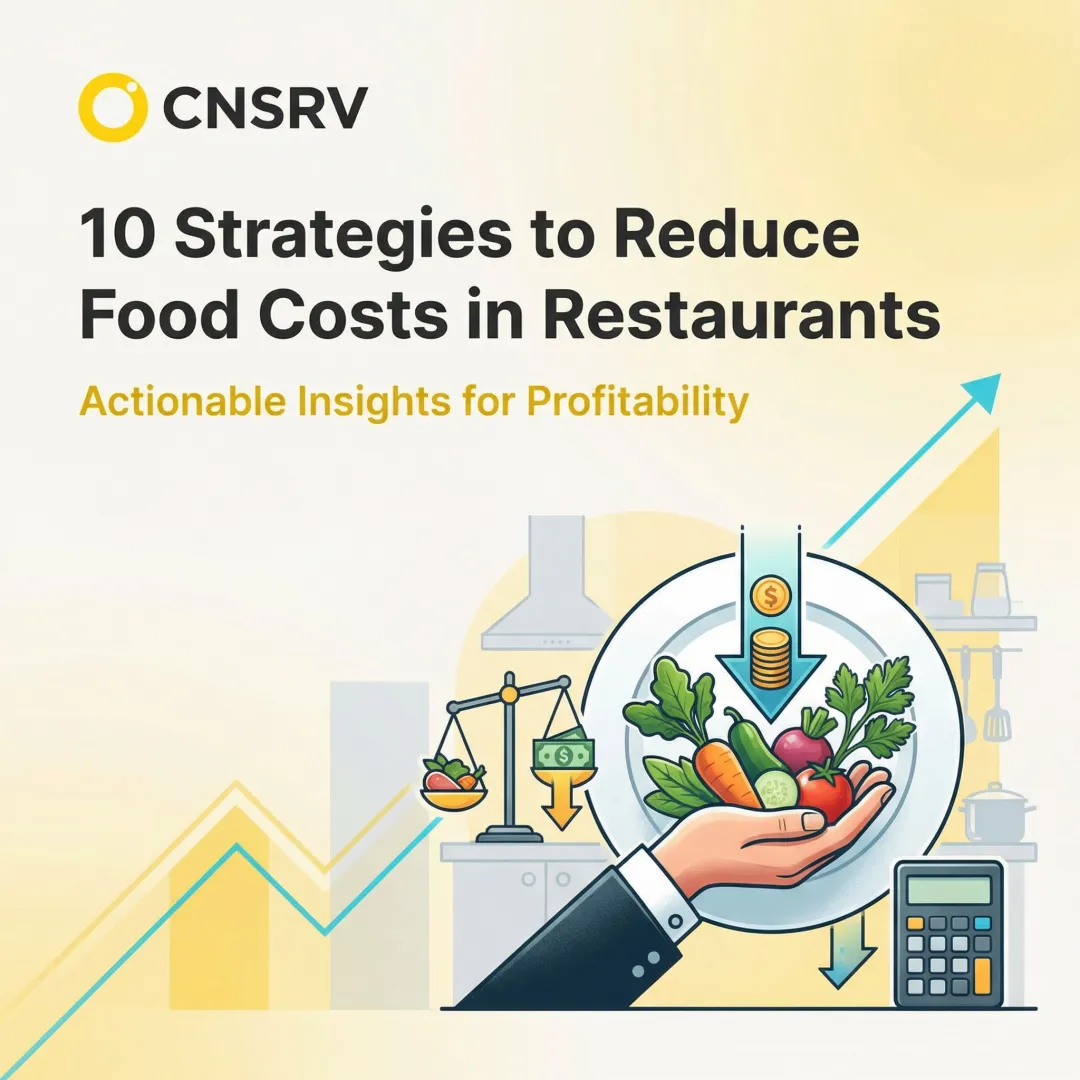
In 2025, 82% of restaurant operators reported higher average food costs than the previous year — part of a 30% surge in total input costs since before the pandemic. Margins are thinning, forecasting is harder, and losses accumulate daily across ingredients, waste, and utilities. A single percentage point increase in food cost can be the difference between a profitable quarter and a breakeven month.
Food costs aren't inherently uncontrollable. Most operators lose ground in one of three areas: purchasing and procurement decisions, day-to-day handling habits, and the operational systems surrounding the kitchen. This guide works through all three — with practical techniques to take back control of one of your most unpredictable expenses.
TL;DR
- Food costs consume 28–35% of restaurant revenue — poor purchasing, prep, and handling decisions push them higher
- Costs build gradually across the full journey from purchasing to serving, not as a single line item
- The biggest drivers are waste, over-ordering, inconsistent portioning, vendor price drift, and utility costs like water usage
- Reducing costs sustainably means tracking, training, and adjusting systems continuously — not a one-time fix
How Food Costs Build Up in a Commercial Kitchen
Food costs rarely appear as a single, visible expense on your monthly statements. Instead, they accumulate across the entire procurement-to-plate journey: ordering, receiving, storing, prepping, cooking, portioning, and serving.
Each handoff point introduces risk—a case of produce that sits too long in the walk-in, a cook who free-pours sauces instead of measuring, a delivery invoice that lists incorrect quantities.
Much of this build-up is gradual and often invisible until inventory audits, cost-of-goods-sold reviews, or end-of-period accounting reveal the gap between what you thought you spent and what you actually spent. This lag makes real-time visibility a prerequisite for control. Without daily tracking mechanisms, operators are flying blind, reacting to problems weeks after they occurred.
Costs compound fastest when multiple small inefficiencies stack up together. Over-ordering combined with improper storage and inconsistent portioning creates a cascade of losses that no single fix can address alone. Common culprits include:
- Ordering based on gut feel rather than usage data
- Storing items without rotation protocols
- Allowing cooks to eyeball portions instead of measuring
Each habit adds a few percentage points to the final food cost ratio until margins evaporate entirely.

Key Cost Drivers for Food Costs
Ingredient Cost Volatility
Ingredient cost volatility is the most visible driver of rising food costs. Supplier pricing fluctuates with seasons, supply chain disruptions, and inflation. Food-away-from-home prices rose 4.1% in 2024 and another 3.8% in 2025, establishing a new baseline that shows no signs of reverting to pre-pandemic levels. Operators who lack contractual clarity or don't monitor invoice accuracy absorb these increases silently, watching their margins shrink without understanding why.
The outbreak of Highly Pathogenic Avian Influenza provides a stark example: egg prices hit a record average of $4.82 per dozen in January 2023, forcing operators to either raise menu prices immediately or accept temporary margin compression. Those without alternative suppliers or menu flexibility suffered the most.
Waste and Spoilage
Waste and spoilage represent the second major driver. The restaurant industry generates approximately 11.4 million tons of food waste annually, with pre-consumer waste—spoilage, overproduction, and trim waste—accounting for a significant controllable portion. Industry estimates suggest restaurants waste between 4% and 10% of food purchased before it ever reaches a customer.
For a restaurant with $1 million in food purchases, that's a loss of $40,000 to $100,000 every year.
Spoilage typically traces back to three compounding failures:
- Over-ordering based on guesswork rather than actual sales data
- Improper storage that allows temperature fluctuations or cross-contamination
- Skipped FIFO rotation, letting older stock expire behind newer inventory
When all three occur together, waste accelerates fast.
Portion Inconsistency
Portion inconsistency is a hidden but high-impact driver. When kitchen staff don't follow standardized recipe specs, actual food cost per dish diverges from theoretical cost with every ticket.
A cook who adds an extra two ounces of protein per plate, across 200 covers a night, can add thousands of dollars to monthly food costs — undetected until the variance report arrives.
This drift is especially damaging because it compounds over time and across multiple stations. When no one is measuring, everyone develops their own interpretation of "correct" portions, and the baseline shifts upward permanently.

Overlooked Operational Costs
Overlooked operational costs—utilities, water usage, and time inefficiencies tied to food handling practices—inflate total kitchen costs but are rarely categorized under "food cost" even though they directly affect profitability. Traditional running-faucet defrosting, for example, can consume 132 gallons of water per hour at standard commercial flow rates, adding thousands of dollars annually to water and sewer bills while degrading food quality through uncontrolled temperature exposure.
Cost-Reduction Strategies for Food Costs
Strategies vary significantly depending on where in the kitchen operation the cost originates. The most effective approach combines upstream decision-making, active daily management, and environmental or systemic changes.
Strategies That Reduce Costs by Changing Decisions
These approaches reduce food cost by altering choices made before ingredients enter the kitchen or before service begins—decisions that have lasting impact on the cost baseline.
Standardize recipes and portion specifications before purchasing
Establishing precise recipe cards—including ingredient quantities, acceptable substitutions, and plate presentation standards—is the foundation of predictable food cost. Without this, every ordering and prep decision is made in the dark. Recipe standardization enables accurate theoretical food cost calculations, which in turn reveal where actual costs are drifting.
Each recipe should specify:
- Exact ingredient quantities by weight or volume
- Acceptable substitutions and their cost implications
- Plating standards and portion sizes
- Yield percentages for trim-heavy ingredients
Use historical sales data to drive purchasing decisions
Forecasting demand based on actual sales history—by day, season, and location—reduces over-ordering and the waste it produces. Guesswork-based ordering is one of the most direct causes of elevated food cost percentages. Modern POS systems capture granular sales data that can predict demand patterns reliably, yet many operators still order based on intuition.
Data-driven purchasing requires:
- Weekly sales reports by menu item
- Seasonal trend analysis
- Event and weather impact tracking
- Supplier lead time integration
Engineer the menu around profitable, efficiently-sourced items
Menu engineering—analyzing which items are high-margin and high-volume versus low-margin and low-volume—allows operators to reduce the number of ingredients carried, lower waste risk, and focus preparation resources on dishes that contribute most to profitability. A menu with 80 items requires far more inventory, creates more waste, and complicates prep compared to a focused menu of 40 well-executed dishes.
Strategic menu design:
- Identifies "stars" (high margin, high volume) to promote
- Eliminates "dogs" (low margin, low volume) that tie up capital
- Reduces SKU count to simplify inventory management
- Leverages cross-utilization of ingredients across multiple dishes

Negotiate vendor contracts with explicit pricing and terms
Locking in pricing, delivery schedules, and quality specifications with suppliers creates a stable cost baseline. Without transparent contracts, small billing errors and price drift accumulate undetected and inflate food costs over time. Operators should review invoices line by line against contracted prices and challenge discrepancies immediately.
Effective contracts include:
- Fixed pricing for specified periods
- Quality specifications and acceptable variance
- Delivery schedules and minimums
- Credit terms for rejected deliveries
Strategies That Reduce Costs by Changing How Food Cost Is Managed
These strategies close the gap between what food costs should be and what they actually are by improving visibility, consistency, and accountability during active kitchen operations.
Track actual vs. theoretical food cost variance regularly
Theoretical food cost represents what spending should be if every recipe were followed perfectly and no waste occurred. A variance of just 1.7% on $1 million in sales equates to $17,000 in lost profit. Tracking the gap between theoretical and actual figures daily surfaces portion drift, kitchen errors, invoicing discrepancies, and potential theft before they compound.
Variance tracking reveals:
- Recipe compliance failures
- Theft or unauthorized consumption
- Supplier billing errors
- Unrecorded waste
Implement FIFO and consistent inventory counting practices
A First-In, First-Out storage rotation system ensures older inventory is used before newer stock, directly reducing spoilage losses. The FDA Food Code mandates that ready-to-eat TCS foods held for more than 24 hours must be marked with a 7-day use-by date, effectively enforcing FIFO through regulatory compliance.
Inventory counts should be performed on a consistent schedule—weekly for high-value items, monthly for shelf-stable goods—to produce comparable data across periods. Without that consistency, variance analysis loses its reliability—making portion auditing the next critical control point.
Audit portion sizes and monitor plate waste
Regularly checking that kitchen staff are following recipe specs—and observing what comes back on bused plates—reveals whether portion sizes are aligned with customer appetite and recipe cost assumptions. Over-portioning is a slow, steady margin leak; under-portioning drives negative reviews and repeat visit rates down.
Effective portion auditing includes:
- Weekly line checks with scales
- Photo documentation of plated standards
- Plate waste tracking by menu item
- Server feedback on customer satisfaction
Modernize defrosting and food handling practices
Traditional running-faucet defrosting methods waste significant volumes of water per shift and can compromise food texture and safety. A single tap running at 2.2 gallons per minute consumes 132 gallons per hour, adding thousands to annual utility bills while exposing food to uncontrolled temperatures that can reach 75–85°F during warmer months.
Closed-loop defrosting systems eliminate this recurring cost without sacrificing food quality. CNSRV's DC:02, for example, uses 98% less water and cuts defrost time in half compared to faucet methods.
Key performance figures for the DC:02:
- Circulates water at ~130 gallons per minute with temperature control held below 70°F
- Completes defrost cycles well within FDA's 4-hour limit
- Saves up to 1,000,000 gallons of water per year per kitchen
- Reduces water and sewer costs by over $21,000 annually
Strategies That Reduce Costs by Changing the Context Around Food Cost
These approaches address the external factors—staff behavior, storage environment, and supplier relationships—that surround food cost without being directly visible in it.
Train all staff levels on cost-awareness and waste reduction behaviors
Food cost control cannot be achieved by management alone. Cooks must follow recipe specs, servers must understand portion expectations, and managers must reinforce accountability daily. Research shows that establishments providing employee training on waste prevention generate 34.5% less mixed waste than those that do not. Training addresses the primary drivers of waste: lack of knowledge and incorrect handling.
Effective training programs cover:
- Recipe adherence and measuring techniques
- FIFO rotation protocols
- Waste tracking and reporting procedures
- Cost implications of common mistakes
Optimize storage conditions to prevent spoilage
Temperature consistency, labeling, shelf organization, and limiting access to high-cost inventory are environmental controls that directly reduce spoilage-related food cost. Improper storage is often the silent driver behind higher-than-expected actual food costs. Walk-ins that fluctuate above 41°F, unlabeled containers that sit for weeks, and disorganized shelving that buries older product all contribute to waste.
Storage optimization includes:
- Daily temperature logging
- Clear date labeling on all containers
- Dedicated zones for raw vs. ready-to-eat items
- Restricted access to high-value inventory
Adjust supplier mix to reflect seasonal availability and pricing cycles
Operators who build relationships with multiple suppliers and adapt menus to seasonal availability reduce exposure to price spikes. They can also take advantage of overstocked items at favorable prices. In 2025, 60% of full-service operators removed items from menus due to supply delays, and 63% shopped alternative suppliers.
Supplier diversification also reduces dependence on a single source during supply disruptions, providing operational resilience when commodity markets spike unexpectedly.

Conclusion
Reducing food costs requires identifying where cost originates—whether in purchasing decisions, daily handling practices, or the broader kitchen environment—rather than applying blanket cost-cutting measures that ignore root causes. A kitchen that slashes portion sizes without addressing waste or over-ordering will frustrate customers without improving profitability.
Food cost management works when it's built into daily operations, not treated as a one-time fix. Operators who track consistently, train staff on handling and portioning, and audit their systems when conditions shift are the ones who hold their margins when food prices rise. The difference between a 32% food cost and a 35% food cost is often the difference between profitability and break-even—and that gap closes with systems, not guesswork.
Frequently Asked Questions
What is a good food cost percentage for a restaurant?
The industry benchmark range is 28–35% of total food sales, though this varies by restaurant type. Limited-service restaurants reported a median of 32.4%, while full-service operators reported 32.0% in 2024. Monitoring this KPI against actual spending is more actionable than targeting a single number.
How is food cost percentage calculated?
Divide total food cost (COGS) by total food sales and multiply by 100. COGS includes beginning inventory plus purchased inventory minus ending inventory. This formula reveals what percentage of every sales dollar goes toward raw ingredients.
What is the difference between actual and theoretical food cost?
Theoretical food cost is what spending should be under perfect conditions—no waste, perfect portions, zero theft. Actual food cost reflects real spending including all losses. The gap between the two pinpoints where losses occur and how much operational inefficiency is costing you.
What is the most common cause of high food costs in restaurants?
Over-ordering, food waste, and inconsistent portioning are the most frequent culprits. Most cases trace back to missing standardized recipes and unreliable inventory tracking — two gaps that quietly inflate costs before they show up in financial reports.
How does food waste directly affect food cost management?
Waste forces restaurants to pay for ingredients that generate no revenue, raising the food cost percentage without any corresponding increase in sales. Reducing waste through FIFO, portion control, and smarter ordering can close a 3–5 percentage point gap in food cost percentage — often without adding a single new sale.
Can operational practices like defrosting methods affect food costs?
Yes. Practices like running-faucet defrosting inflate water utility bills and can degrade ingredient quality, increasing the effective cost of each portion. More efficient defrosting systems reduce both the utility expense and the risk of food quality losses while maintaining full health code compliance.