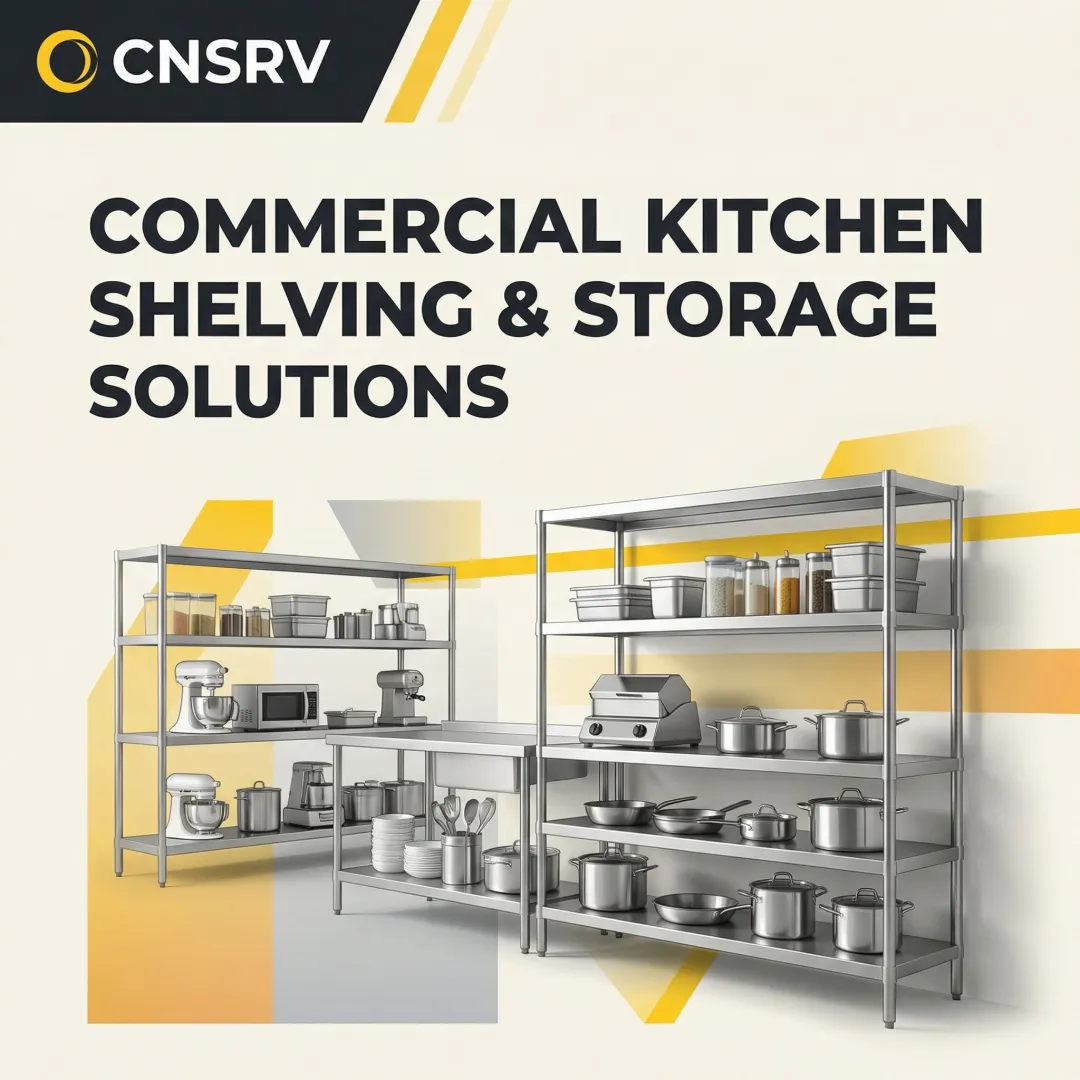
This guide covers the main types of commercial kitchen storage racks, how to choose the right materials for different kitchen zones, and proven strategies for organizing by area to improve workflow and compliance. It's designed for restaurant owners, food service operators, and kitchen managers looking to optimize their kitchen layout and storage systems without sacrificing food safety or operational efficiency.
TL;DR
- Commercial kitchens require durable, NSF-compliant shelving to maintain organization and food safety
- Wire shelving (metro-style) offers maximum flexibility and airflow; solid shelving suits specific storage needs
- Organizing by zone (prep, cook, dry storage, cold storage) improves workflow efficiency and reduces cross-contamination risk
- All shelving must meet food safety standards: NSF certification, 6-inch floor clearance, and easily cleanable surfaces
- Regular inspection and maintenance extend shelving life and prevent code violations
Types of Kitchen Storage Racks and Shelving for Commercial Kitchens
Selecting the right shelving starts with understanding the fundamental distinction between freestanding units and wall-mounted options. Freestanding shelving serves as the workhorse of commercial kitchens, offering high load capacity and flexibility for walk-in coolers, dry storage, and prep areas. Wall-mounted shelving saves floor space in tight kitchens and keeps frequently used items within arm's reach at dedicated stations.
Freestanding Wire Shelving (Metro-Style Racks)
Wire shelving units—often called "metro-style" after the industry pioneer InterMetro—dominate commercial kitchens. These modular systems can be reconfigured as kitchen needs change, support heavy loads (typically 600–800 lbs per shelf), and promote airflow that prevents moisture buildup and mold growth.
The open-wire design allows cold air to circulate freely around stored products, which is essential for maintaining FDA-mandated cold holding temperatures of ≤41°F. Research shows that blocking airflow in refrigerated environments can increase product temperature by over 5°C and significantly delay cooling, creating dangerous conditions for bacterial growth.
This makes wire shelving the preferred choice for walk-in coolers and freezers where temperature consistency directly affects food safety. High product visibility also reduces retrieval time and lowers the risk of forgotten inventory spoiling at the back of a cooler.
Wall-Mounted Shelving
Wall-mounted stainless steel shelves excel in prep and cook zones where floor space is limited. They keep spices, utensils, and small equipment at eye level and within arm's reach, reducing unnecessary movement during service.
Key considerations for wall-mounted units:
- Weight capacity is lower than freestanding units (typically 200–400 lbs per shelf)
- Requires proper anchoring into wall studs with rated expansion anchors
- Best for frequently accessed items rather than bulk storage
- Best fit for small-footprint kitchens and dedicated prep stations
Mobile Shelving and Utility Carts
Mobile shelving units with locking casters add operational flexibility, particularly for catering operations, shared-use kitchens, or facilities that reconfigure for different service types.
Critical capacity warning: While individual shelves may be rated for 600–800 lbs, mobile units are typically capped at 900–1,000 lbs total capacity regardless of shelf ratings. Overloading mobile units is a common failure point that can result in caster collapse and safety hazards.
Specialty Racks (Pan Racks, Dunnage Racks, Pot Racks)
Specialty racks address specific storage challenges:
- Sheet pan/bun pan racks: Vertical storage for bakeries and high-volume kitchens, holding dozens of sheet pans in a compact footprint
- Dunnage racks: Heavy-duty platforms supporting 1,500–4,000 lbs that elevate bulk items like flour sacks, kegs, and beverage cases off the floor; most stand 12 inches high, exceeding the 6-inch health code minimum and improving airflow around stored items
- Pot racks: Ceiling-mounted or overhead systems that maximize vertical space in prep areas while keeping cookware accessible

Choosing the Right Shelving Material for Your Commercial Kitchen
Material selection must prioritize durability and hygiene over aesthetics. Heat, moisture, and heavy loads in commercial kitchens demand materials that withstand harsh conditions while remaining easily cleanable and corrosion-resistant.
Stainless Steel Shelving
Stainless steel is the top choice for commercial kitchens. It handles high-temperature and high-humidity environments near dishwashers, steam equipment, and walk-in coolers without degrading — and it's built for serious load capacity.
Benefits of stainless steel:
- Resistant to bacteria and rust
- Withstands extreme temperature fluctuations
- Easy to sanitize with food-safe cleaners
- Long service life with minimal maintenance
Critical warning: Never use chlorine or bleach-based cleaners on stainless steel—they cause pitting and permanent surface damage.
Chrome-Plated Wire Shelving
Chrome-plated wire shelving offers a cost-effective alternative to stainless steel for dry storage and pantry areas. However, chrome is susceptible to rust when exposed to constant moisture and condensation, making it unsuitable for walk-in coolers, freezers, or areas near dishwashers.
Use chrome shelving only in dry storage zones. Corrosion leads to peeling finish and exposed steel—a frequent health inspection violation.
Epoxy-Coated Shelving
Epoxy-coated wire shelves add a layer of rust and corrosion resistance beyond chrome, making them better suited for coolers and humidity-heavy environments. These shelves feature a zinc substrate with an epoxy finish (often green or gray) that protects against moisture.
Epoxy-coated shelving is rated for temperatures from -20°F to 120°F+ and is the preferred choice for walk-in freezers and refrigerators. Many epoxy coatings include antimicrobial protection for added food safety.
Solid vs. Wire Shelving: When to Use Which
| Wire Shelving | Solid Shelving | |
|---|---|---|
| Best for | Walk-in coolers, freezers, bulk dry storage | Prep areas, front-of-house, small containers |
| Airflow | Excellent — prevents moisture buildup | Poor — traps moisture if not cleaned regularly |
| Visibility | Easy visual inspection of stored items | Obstructs view of lower shelves |
| Small items | Fall through (shelf liners required) | Fully supported — no liner needed |
| Refrigeration | No airflow interference | Can create warm spots in coolers |
| Appearance | Utilitarian | Cleaner look for customer-facing areas |

Use-case guidance: Choose wire shelving for coolers and bulk dry storage; select solid shelving for prep areas with small containers and ingredients.
Organizing Your Commercial Kitchen by Zone
Structuring storage around defined zones cuts labor time, reduces cross-contamination risk, and keeps prep moving without bottlenecks. High-performing commercial kitchens build around four core zones: dry storage, cold storage, prep, and cook.
Dry Storage Zone
Proper dry storage setup requires:
- NSF-rated shelving elevated at least 6 inches off the floor (per food safety code)
- Organization by frequency of use: Most-used items at eye level (48-60 inches), heavy items on lower shelves
- Separation by category: Canned goods, dry goods, single-use packaging stored separately
Label all shelves clearly and implement FIFO (First In, First Out) rotation to minimize waste. Case studies show FIFO implementation can reduce food waste by up to 40% in distribution operations.
Cold Storage Zone (Walk-In Coolers and Freezers)
Organize walk-in cooler shelving to maintain food safety compliance:
Vertical storage hierarchy (top to bottom):
- Ready-to-eat foods (produce, dairy, cooked meats)
- Seafood/fish (cook temp: 145°F)
- Whole cuts of beef and pork (cook temp: 145°F)
- Ground meat and ground fish (cook temp: 155°F)
- Whole and ground poultry (cook temp: 165°F)
This hierarchy is mandated by FDA Food Code §3-302.11 to prevent cross-contamination from drips. Storing raw chicken above beef is an automatic critical violation.

Additional cold storage best practices:
- Use labeled containers with dates
- Implement FIFO rotation
- Maintain clear aisle space for cleaning and inspection
Prep Zone
Prep station shelving should prioritize accessibility:
- **Wall-mounted shelves above prep tables** for frequently used tools and ingredients
- Under-counter shelving for mixing bowls, cutting boards, and containers
- Keep work surfaces clear to maximize usable prep space
Store prep ingredients in clear, labeled containers at eye level. Reserve lower shelves for backup supplies and heavy equipment.
Cook Zone
Shelving near cooking equipment requires heat-resistant materials:
- Stainless steel wall shelving for spices, sauces, and utensils
- Overhead pot racks or hanging rail systems for pans and cookware
- Mobile utility carts for moving hot items efficiently between stations
Never install chrome or epoxy-coated shelving directly above cooking equipment—heat can damage finishes and create food safety hazards. Never install chrome or epoxy-coated shelving directly above cooking equipment—heat can damage finishes and create food safety hazards. When each zone is properly configured, the kitchen operates as a coordinated system rather than a collection of individual stations.
Food Safety and Compliance Standards for Commercial Kitchen Shelving
Commercial kitchen shelving must meet local health department codes, which typically mandate a minimum clearance from the floor (commonly 6 inches), easily cleanable surfaces, and materials that won't contaminate food. Non-compliance results in failed inspections or closures.
NSF Certification: What It Means and Why It Matters
NSF (National Sanitation Foundation) certification means a product has been independently tested and verified as safe for food contact environments. NSF/ANSI 2-2025 establishes minimum food protection and sanitation requirements for materials, design, and fabrication of commercial kitchen equipment.
NSF-listed shelving reduces inspection risk and shows your kitchen takes food safety seriously. That matters practically: FDA Food Code §4-205.10 deems equipment certified by an ANSI-accredited program like NSF to be compliant, and some states — California included — explicitly require NSF certification for new equipment. You can verify products at info.nsf.org/certified/food/.
Spacing, Clearance, and Load Capacity Rules
Compliance checkpoints:
- Elevate floor-mounted equipment at least 6 inches per FDA Food Code §4-402.12 to allow cleaning and prevent pest harborage
- Stay within manufacturer-rated load capacity; overloaded shelving is among the most common inspector citations
- Use non-absorbent, corrosion-resistant materials in all food prep areas
- Install shelving to allow complete cleaning of every surface, including undersides and supports

Inspectors frequently cite rusted, hard-to-clean, or improperly elevated shelving. Maintain documentation of load ratings and installation specifications for inspection readiness.
Installation and Maintenance Tips for Long-Lasting Shelving
Proper Installation Practices
Wall-mounted units:
- Anchor into wall studs or use appropriate wall anchors rated for the load
- Use 1/2" or 5/8" expansion anchors (such as Kwik Bolt II or Red Head Trubolt) — see Metro Super Erecta installation specs for reference
- Apply proper torque: 50 ft-lb for 1/2" bolts; 80 ft-lb for 5/8" bolts
- Embedment depth: 2.5" to 4" depending on load requirements
Freestanding units:
- Level units during assembly according to manufacturer specs
- Lock all adjustable shelves securely at desired heights
- Verify caster locks function properly on mobile units
Regular Inspection and Cleaning
- Weekly: Wipe-downs with food-safe sanitizers
- Monthly: Inspect for corrosion or structural weakness (especially chrome shelving near moisture)
- Immediate replacement: Any shelving showing rust, sharp edges, or warping
Polymer shelf plates can be removed and run through a commercial dishwasher, which Cambro notes significantly improves sanitation compliance.
When to Upgrade Your Shelving
Replace shelving when:
- Visible rust or corrosion appears
- Frames are bent or unstable
- Coatings absorb persistent odors
- Kitchen operations scale up and existing storage capacity is insufficient
Rusted shelving is a documented health code violation — address deteriorating equipment before your next inspection, not after.
Frequently Asked Questions
What is the best shelving material for a commercial kitchen?
Stainless steel is the top choice for wet and high-traffic areas due to its durability and corrosion resistance. Epoxy-coated wire shelving suits coolers and freezers. Match the material to the zone: stainless for heat and moisture, epoxy-coated wire for cold storage.
Do commercial kitchen shelves need to be NSF certified?
NSF certification isn't federally mandated, but most local health codes require shelving to meet NSF or equivalent standards for food contact environments. NSF-certified options are the safest choice for passing inspections and demonstrating compliance.
How far off the floor should commercial kitchen shelves be?
Most health codes require at least 6 inches of clearance between the bottom shelf and the floor to allow for cleaning and prevent pest harborage. Some specialty racks like dunnage systems provide 12 inches of clearance. Always verify local code requirements.
What is the difference between wire shelving and solid shelving in a commercial kitchen?
Wire shelving promotes airflow (ideal for coolers and dry storage) and allows visual inspection of stored items. Solid shelving prevents small items from falling through, making it better suited for prep areas storing containers and jars.
How much weight can commercial kitchen shelving hold?
Heavy-duty commercial shelving typically supports 400–800 lbs per shelf, with stationary units reaching 2,000–2,400 lbs total capacity; mobile units are capped at 900–1,000 lbs total. Always verify manufacturer-rated load capacity before stacking heavy items.
How do I organize a commercial kitchen for maximum efficiency?
Use a zone-based approach — dedicated dry storage, cold storage, prep, and cook zones — with shelving matched to each area. Apply FIFO rotation with date labels, store raw proteins on the lowest cooler shelves to prevent cross-contamination, and keep high-frequency items at eye level.