Introduction
Multi-location food service operators face a relentless challenge: keeping food quality consistent across every site, controlling costs that compound with each new location, and running complex operations across dispersed kitchens without losing control. The centralized kitchen model addresses all three—consolidating production into one purpose-built facility that supplies multiple satellite locations.
This guide breaks down what centralized kitchen operations actually look like in practice. You'll find:
- Who benefits most from the model
- The core operational and cost advantages
- How day-to-day production and distribution work
- Sustainability factors that affect your bottom line
- Key decisions to evaluate before making the shift
TLDR
- A centralized kitchen consolidates food prep and bulk cooking in one facility, distributing finished or semi-finished products to multiple service locations
- Delivers consistent quality across all sites while reducing labor costs, unlocking bulk purchasing power, and simplifying logistics
- Requires upfront investment in equipment, staffing, and distribution infrastructure, but generates significant long-term savings
- High-volume defrosting is a hidden water cost—modern systems like the CNSRV DC:02 cut water use by 98% vs. traditional running-faucet methods
- Success hinges on cold chain management, technology integration, and FDA Food Code transport compliance
What Is a Centralized Kitchen?
A centralized kitchen is a dedicated commercial food production facility where ingredients are prepped, cooked in bulk, and portioned before being distributed to satellite restaurant locations or service points. Unlike a traditional kitchen that serves a single on-site dining operation, a centralized facility functions as the production hub for an entire network of locations.
The operating model centers on volume efficiency: centralized kitchens handle core prep tasks—bulk cooking, portioning, packaging, and sometimes full meal assembly. Individual branch locations receive these prepared components and only need to handle final assembly, reheating, or service, which significantly reduces the equipment and staffing burden at each satellite site.
Common terminology includes:
- Central production kitchen — the preferred term in manufacturing-style food operations
- Commissary kitchen — common in catering and mobile food service contexts
- Central production unit (CPU) — used by multi-unit operators to describe the facility's role within a broader distribution system
These terms are frequently used interchangeably across the industry. A single centralized facility can supply anywhere from a handful of locations to dozens of outlets—some large-scale operations run 50+ sites from one production center.
Who Uses Centralized Kitchen Operations?
Catering Companies
Catering companies use centralized kitchens to produce large food volumes for events and functions from a single facility, eliminating the need to rent multiple kitchen spaces for different events. Caterers can invest in specialized equipment once rather than duplicating resources across locations, while still maintaining the capacity to serve multiple simultaneous events at different venues.
Restaurant Chains and F&B Groups
Multi-location restaurant brands and franchise groups depend on central kitchens to standardize recipes, portion sizes, and food quality across all outlets. New menu items can be perfected and produced at the central facility before distribution, ensuring a consistent brand experience customers recognize at every location.
According to research, this model lets chains concentrate high-skill culinary work in one place while satellite sites focus on assembly and service. The result: tighter quality control with less operational complexity at each outlet.
Hotels and Institutional Food Service
Hotel groups and institutional operators—including corporate cafeterias, school districts, and healthcare facilities—use centralized kitchens to enforce uniform quality across all service points. Key operational advantages include:
- Predictable bulk production schedules that match institutional demand patterns
- Consistent portion sizes and nutritional standards across all service points
- Streamlined procurement through consolidated purchasing
School districts have documented significant efficiency gains, with centralized operations generating at least 40 meals per labor hour compared to just 16–20 meals per labor hour in self-operated kitchens.
Key Benefits of Centralized Kitchen Operations
Consistency and quality control: Centralizing food production under one roof—with standardized recipes, equipment, and trained staff—eliminates the variability that occurs when each location preps independently. For multi-location operators, that consistency protects brand integrity: customers expect the same experience whether they're visiting location one or location ten.
Cost reduction through economies of scale: Bulk ingredient purchasing drives down per-unit food costs, enables stronger supplier relationships, and reduces over-ordering and spoilage that occurs when inventory is managed separately across sites. Research shows that consolidating procurement to one location can reduce food costs by 1–2% at minimum, with some operations achieving even greater savings as they optimize purchasing power.
Labor efficiency and talent concentration: Instead of requiring a full team of skilled kitchen staff at every location, a centralized model concentrates high-skill culinary work in one place, reducing total labor costs while elevating production quality. One school district found that consolidating from three sites to one purpose-built facility cut production payroll by roughly one-third.

Satellite locations can then run leaner, lower-cost teams focused entirely on final assembly and service.
Reduced kitchen footprint at satellite locations: Individual locations can operate with smaller, simpler kitchens when most production happens centrally, freeing up floor space for dining or other revenue-generating uses. Smaller kitchen footprints also mean lower equipment costs, utility expenses, and maintenance overhead at every site, letting operators reinvest those savings across the network.
Faster and more reliable scaling: The centralized model makes opening new locations significantly easier, since each new site doesn't need to establish its own full kitchen infrastructure or operational workflows from scratch. New locations simply plug into the existing central supply chain, which reduces time-to-market and lowers the capital requirements for expansion.
How a Centralized Kitchen Operates Day-to-Day
Procurement and Inventory Management
Centralized purchasing consolidates what would otherwise be dozens of separate supply chains into a single, coordinated operation. The core workflow runs through three stages:
- Orders placed in bulk through consolidated supplier relationships
- Ingredients received, inspected, and stored at the central facility
- Distribution to satellite locations scheduled against projected demand
This eliminates the administrative overhead of each location managing its own vendors and gives operators clear visibility into inventory levels and costs across the entire system.
Food Production and Batch Prep
High-volume production moves ingredients through dedicated prep stations in sequence, including washing, cutting, marinating, cooking, and portioning, using commercial-grade equipment built for batch output. Standardized recipes and production schedules lock in consistency: every batch meets the same quality benchmarks regardless of which team member is running that shift.
Packaging and Labeling
Proper packaging for distribution is critical to food safety compliance. Cooked and prepped items are labeled with preparation dates, use-by dates, and handling instructions before transport. FDA Food Code requirements mandate that food transported to satellite locations must be labeled with the product name and the date packaged — a non-negotiable step before any item leaves the central facility.
Cold Chain and Distribution Logistics
Maintaining safe food temperatures during transport requires insulated containers, refrigerated vehicles, and carefully timed delivery windows. The 2022 FDA Food Code requires food transported to satellite locations to be equipped with "verifiable electronic monitoring devices" to ensure times and temperatures are tracked throughout transit. Distribution logistics must align with each satellite location's service hours and storage capacity to prevent bottlenecks or spoilage.
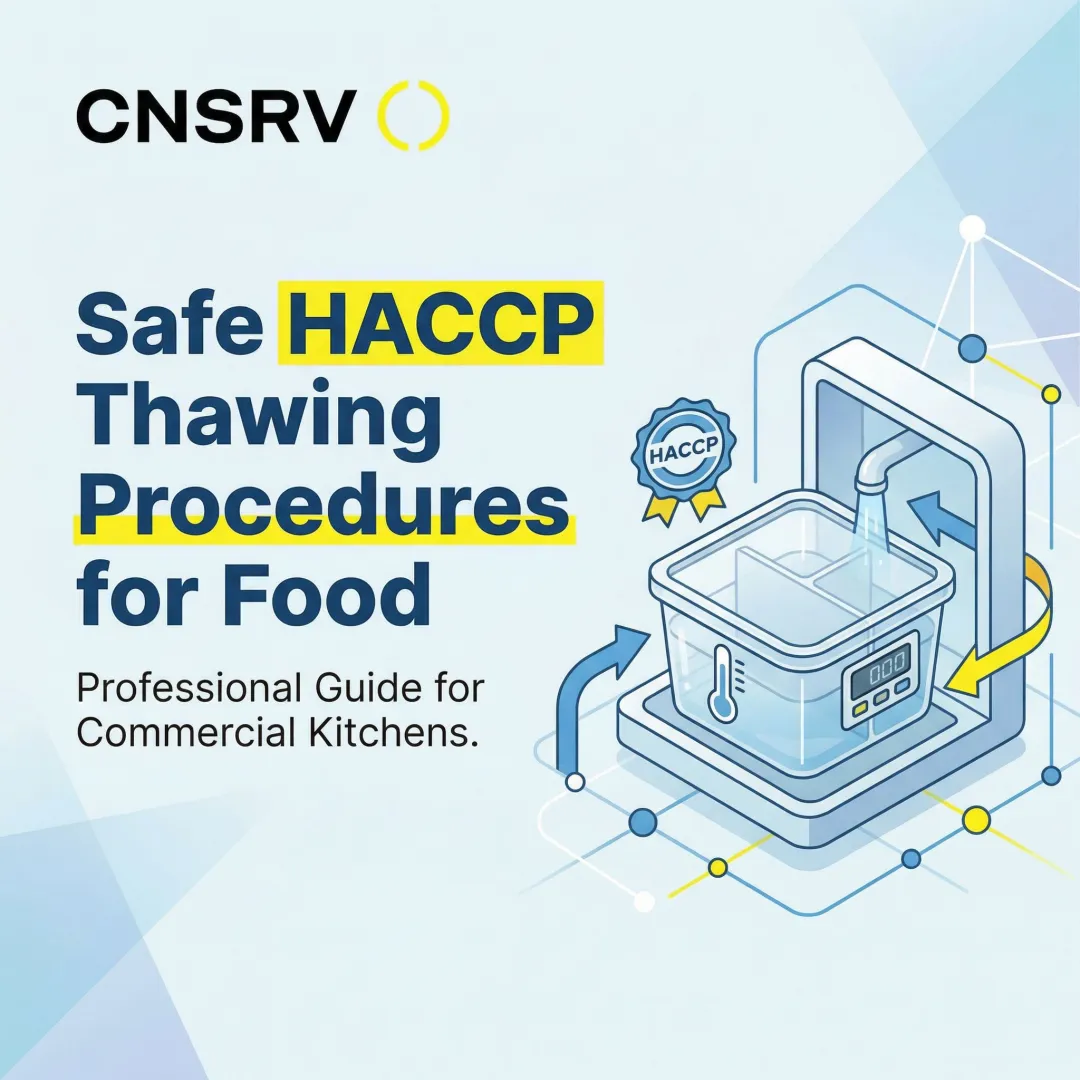
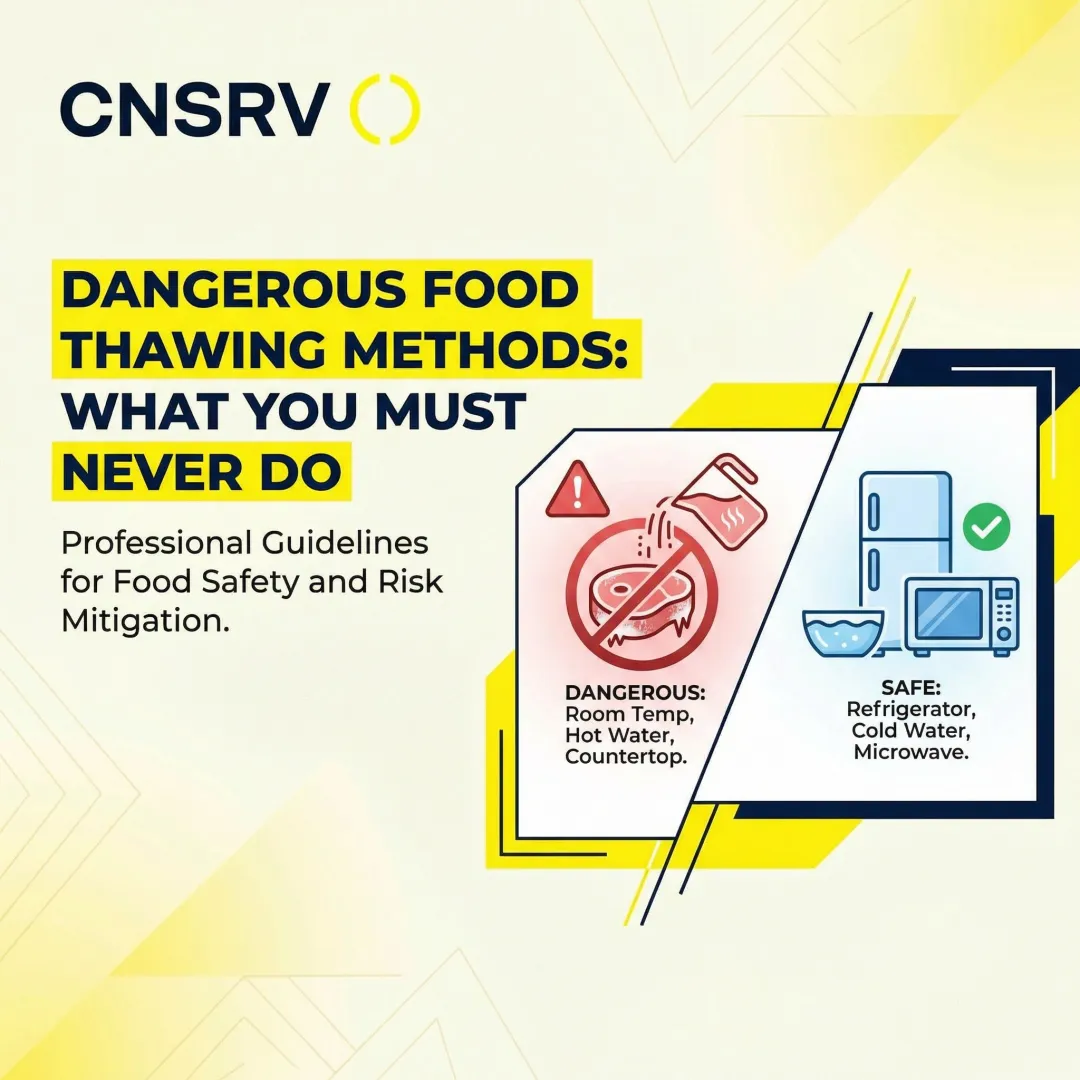
Defrosting at Scale
Centralized kitchens regularly handle large volumes of frozen product that must be thawed safely before entering the production workflow. The traditional method — defrosting under running water — consumes enormous volumes of water at production scale. Research demonstrates that the standard running water method uses 187 to 387 gallons per thaw event for just 2–5 lbs of food, raising both water costs and sustainability concerns. Systems like CNSRV's DC:02 address this directly, using controlled water agitation to thaw product in roughly half the time while cutting water consumption by 98%.

Sustainability and Operational Efficiency in Centralized Kitchens
At centralized production scale, water bills, energy consumption, and waste disposal costs are magnified — small inefficiencies compound into significant cost drains. Regulatory pressure around commercial water use is also intensifying across U.S. markets, making efficiency improvements both an environmental and financial priority.
Food Waste Reduction
Bulk production with centralized inventory tracking enables tighter waste monitoring, more accurate demand forecasting, and better use of ingredients before spoilage. Studies show that implementing cook-chill systems can cut food waste by up to 30% through precise portioning and extended shelf life, reducing both waste disposal costs and food cost percentage.
Defrosting: A Hidden Water Cost
When defrosting large volumes of frozen food under a running faucet, a centralized facility can waste hundreds of thousands of gallons of water annually. The CNSRV DC:02 defrosting system addresses this directly: the NSF-listed closed-loop system uses 98% less water than the traditional running-faucet method, saving up to 1,000,000 gallons per year per kitchen while maintaining full health code compliance with no installation required.
Energy Efficiency Strategies
Centralized kitchens have several practical levers for cutting energy costs:
- Schedule batch cooking to reduce equipment idle time
- Use ENERGY STAR certified commercial appliances where possible
- Optimize refrigeration and cold-chain logistics to minimize energy draw
According to EPA data, ENERGY STAR certified steam cookers use approximately 60% less energy than standard models, while certified dishwashers are 40% more energy and water efficient — generating annual utility savings of $1,300 to $4,100 per unit.

What to Consider Before Setting Up a Centralized Kitchen
Initial investment and financial planning: Setting up a centralized kitchen requires significant upfront capital for facility space (owned or leased), commercial-grade equipment, food safety infrastructure, and staffing. Operators need a thorough cost-benefit analysis weighing setup costs against projected savings from labor reduction, bulk purchasing, and overhead consolidation. Case studies show that facility costs can range from $1,555 to $2,888 per square foot depending on scope and specifications, making careful financial planning essential before launch.
Logistics and distribution system design: The success of a centralized kitchen depends entirely on the reliability of its distribution network. Operators should plan routes, vehicle requirements, delivery frequency, and cold-chain protocols before launch—and establish clear communication channels between the central facility and each satellite location to handle order changes or fulfillment issues.
Technology and software requirements: Effective centralized operations require restaurant management or inventory software that provides real-time stock visibility, production scheduling, order management across branches, and distribution tracking. Choosing the right platform before launch prevents the costly fulfillment errors that come from manually managing multi-location supply chains manually. Systems should treat the commissary as a vendor, automating internal transfers, invoicing, and inventory adjustments between the central hub and satellite locations.
Frequently Asked Questions
What is the difference between a centralized kitchen and a ghost kitchen?
A centralized kitchen produces food for existing branded locations within a chain or network, functioning as a production hub for the business's own outlets. A ghost kitchen (or dark kitchen) is a delivery-only facility operating without front-of-house service, producing food for direct delivery to consumers. The two models serve different purposes and can sometimes overlap in multi-concept facilities.
How much does it cost to set up a centralized kitchen?
Costs vary widely based on facility size, location, and equipment needs. Key expenses include space acquisition, commercial equipment ($40,000–$200,000+), permits, staffing, and distribution infrastructure — with total costs ranging from tens of thousands to several million dollars.
How do centralized kitchens maintain food safety and health code compliance?
Compliance centers on temperature control (cold holding ≤41°F, hot holding ≥135°F), HACCP planning with documented critical control points, and proper labeling with prep and use-by dates. FDA Food Code regulations also require electronic monitoring devices on transport vehicles.
How many locations can one centralized kitchen realistically serve?
This depends on production capacity, distribution range, and delivery frequency. Well-designed central kitchens can serve anywhere from 5 to 50+ locations depending on facility size and logistics infrastructure. School districts have documented single facilities serving 70+ schools, while commercial operations typically support 4-20 restaurant locations from one central hub.
What are the biggest operational challenges of running a centralized kitchen?
The top challenges are distribution logistics (schedules and cold chain integrity), demand variability across locations, high upfront capital investment, and FDA Food Code compliance for transport. Each requires deliberate planning and the right operational systems to manage effectively.
How do you maintain food freshness and quality during distribution from a centralized kitchen?
Use temperature-controlled packaging and vehicles, tight delivery scheduling, and clear labeling with use-by dates and handling instructions. Train satellite staff on proper storage and reheating, and use electronic monitoring devices to verify temperatures stay within safe ranges in transit.