Introduction
Blast chillers are the gold standard for rapid food cooling—but at $3,300 to $60,000+, with significant floor space requirements and complex installation, they're out of reach for many restaurants, catering operations, and newer foodservice establishments.
That doesn't eliminate the compliance obligation. The FDA Food Code requires cooked Time/Temperature Control for Safety (TCS) foods to drop from 135°F to 41°F within six hours to prevent bacterial growth in the temperature danger zone (41°F–135°F). Miss that window, and you're looking at both a food safety risk and a potential health code violation.
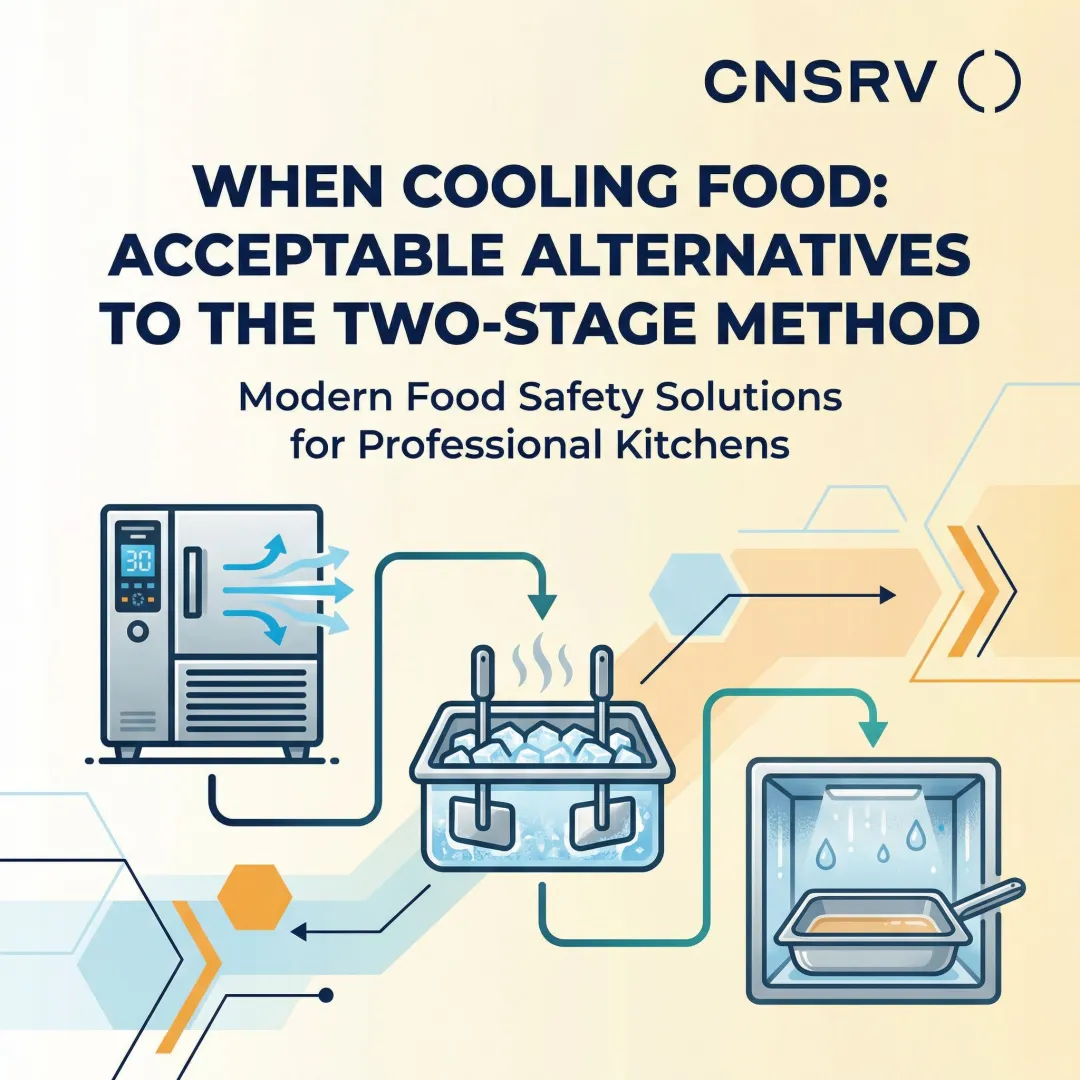
This article covers five practical, FDA-recognized blast chiller alternatives suited to commercial kitchens, along with guidance on which approach fits your operation's food types, volume, and workflow.
TLDR
- Blast chillers rapidly cool cooked food through the danger zone, but practical alternatives exist for budget-conscious kitchens
- Five main alternatives: ice bath method, ice paddles/cooling wands, shallow pan method in walk-in coolers, tumble/kettle chillers, and running cold water immersion
- All alternatives must meet FDA standards: 135°F to 70°F within 2 hours, then down to 41°F within 4 more
- Each method differs in cost, labor, and food-type fit — choose based on your operation's volume and workflow
- Water-based methods consume significant resources, so sustainability-focused kitchens should weigh efficiency carefully
What Is a Blast Chiller and Why Do Kitchens Look for Alternatives?
A blast chiller uses high-velocity cold air to extract heat from food rapidly, bringing large batches from cooking temperature (around 160°F) to safe storage temperature (41°F or below) far faster than conventional refrigeration. Rapid cooling is essential for FDA/HACCP compliance: improper cooling contributed to 504 foodborne illness outbreaks in restaurants and delis between 1998 and 2008, according to CDC data.
The equipment's compressors and specialized airflow systems are engineered to push food through the temperature danger zone before bacteria can multiply.
Common Barriers to Blast Chiller Adoption
Several factors push kitchens toward alternatives:
- Capital cost: Entry-level units start around $3,300, mid-range reach-in models run $10,000–$30,000, and institutional roll-in units exceed $60,000
- Floor space: A typical reach-in model like the Traulsen TBC13 measures 41″L × 34.5″D × 74″H—substantial real estate in tight kitchens
- Installation requirements: Units demand 208–230V electrical service, dedicated 20A circuits, floor drains (or condensate evaporators), and 5.5″–12″ clearance on all sides
- Maintenance overhead: Specialized service contracts and parts add ongoing operational costs

The National Restaurant Association's 2023 State of the Restaurant Industry report confirmed many operators were postponing capital investments due to economic pressures, making blast chillers a difficult justification for smaller operations.
Alternatives Can Meet Compliance Standards
Alternatives are not automatically inferior. When executed correctly and consistently, methods like ice baths, ice paddles, and shallow pan cooling can meet FDA time-temperature requirements and preserve food quality. The key is consistent protocol execution and verifying internal temperatures with a calibrated probe thermometer at each stage of the cooling process—not just at the start or finish.
Top Blast Chiller Alternatives for Efficient Food Cooling
These five methods represent the most widely used and health-code-compatible alternatives to blast chillers, each suited to different food types, kitchen sizes, and budgets.
Ice Bath Method
The ice bath is one of the most accessible alternatives: food containers are submerged in a mixture of ice and cold water, stirred periodically to accelerate heat transfer. It works best for soups, sauces, stocks, and liquid-heavy dishes in pots or hotel pans. The FDA Food Code explicitly approves this method in Section §3-501.15, listing "in an ice-water bath" and "stirring the food in a container placed in an ice-water bath" as accepted cooling techniques.
Zero equipment cost, immediate setup, and effective temperature reduction when properly executed make this method a kitchen staple. The Washington State Department of Health recommends that ice amounts should equal or exceed the amount of food being cooled. Metal containers transfer heat more effectively than plastic, and frequent stirring with a sanitized utensil breaks up the warmer core, distributing cold evenly throughout the product.
Key failure point: Insufficient ice or lack of agitation. Ice must be replenished regularly as it melts, and food must be stirred every few minutes to maintain heat transfer efficiency.
| Aspect | Details |
|---|---|
| Ideal Food Types | Soups, stocks, sauces, stews, and liquid-based dishes in deep containers |
| Cost to Implement | Low—requires only ice, water, and a large vessel or sink |
| Key Limitation | Ice must be replenished regularly; inconsistent cooling if food is not stirred |
Ice Paddles / Cooling Wands
Ice paddles (also called cooling wands) are hollow plastic tools filled with water and frozen solid. They are inserted directly into hot liquid foods and stirred to pull heat out rapidly from the inside of the batch. The FDA Food Code recognizes "using cleaned and sanitized ice wands" as an approved cooling method, and many commercial-grade paddles are certified to NSF/ANSI Standard 2 (Food Equipment) and Standard 51 (Food Equipment Materials).
Ice paddles cool food from the inside out rather than from the outside in, cutting cooling time significantly for dense or deep containers. They're inexpensive (2-liter models cost around $28, while 4-liter models run $47–$55), reusable, and easy to keep on hand—but require advance planning since they must be pre-frozen.
Manufacturer guidance: San Jamar recommends freezing paddles overnight, while Vigor offers two options: freeze for 24 hours or fill with ice and cold water for immediate use.
| Aspect | Details |
|---|---|
| Ideal Food Types | Soups, chili, risotto, gravies, and thick liquid dishes |
| Cost to Implement | Very low—ice paddles typically cost under $55 each |
| Key Limitation | Must be pre-frozen before each use; not suitable for solid proteins or portioned items |
Shallow Pan Method in a Walk-In Cooler
The shallow pan method involves spreading hot food into shallow hotel pans (2 inches or less in depth) and placing them uncovered in a walk-in cooler. This allows maximum surface area exposure to cold air and is standard practice in high-volume kitchens for solid foods like roasted proteins, rice, and vegetables. The FDA Food Code explicitly recognizes "placing the food in shallow pans" as an approved rapid cooling technique in Section §3-501.15.
This method requires no additional equipment beyond what most commercial kitchens already own. Research supports that food depths exceeding 3 inches are less likely to meet FDA time-temperature requirements, making the 2-inch rule a critical best practice.
Common failure point: Overcrowding the walk-in or using deep pans undermines effectiveness. The FDA requires containers be "arranged to provide maximum heat transfer" and "loosely covered, or uncovered if protected from overhead contamination."
Stacking pans blocks air circulation and holds heat—a citable violation during health inspections. Montgomery County, MD, specifically lists "severely overcrowded/overstocked storage" as a food inspection violation.
| Aspect | Details |
|---|---|
| Ideal Food Types | Solid proteins, grains, vegetables, casseroles, and portioned cooked items |
| Cost to Implement | Minimal—standard hotel pans and an operational walk-in cooler |
| Key Limitation | Requires sufficient walk-in space and airflow; does not work for thick liquid-heavy dishes |

Tumble Chiller / Kettle Cooler
Tumble chillers are specialized equipment designed for liquid and semi-liquid foods in sealed pouches or cook-chill bags. Food is cooked, sealed, and then tumbled in cold water to rapidly extract heat. Kettle coolers (counterflow or jacketed) serve a similar purpose for soups and sauces produced in large steam kettles. The Groen Model CKTC-320, for example, is a 320-gallon batch tumble chiller that cools bagged products from 180°F to 40°F in approximately 60 minutes.
Key differentiator: Tumble chillers are among the closest in performance to blast chillers for liquid-heavy, high-volume production environments. They're commonly used in institutional foodservice, hospitals, correctional facilities, and large catering operations. They offer high temperature consistency and reduce cross-contamination risk because food stays sealed throughout the process.
Pricing note: Due to large scale, custom configurations, and installation requirements, pricing is typically obtained directly from manufacturers on a per-project basis rather than through published price lists.
| Aspect | Details |
|---|---|
| Ideal Food Types | Soups, sauces, purées, cook-chill pouches, and high-volume liquid production |
| Cost to Implement | Moderate to high—equipment costs vary by capacity and configuration |
| Key Limitation | Requires compatible cook-chill packaging; less practical for solid or portioned foods |
Running Cold Water Immersion
The running cold water method involves placing sealed food containers or vacuum-sealed pouches in a sink with cold running water continuously flowing over them to carry heat away. This is a widely used workaround in kitchens that lack dedicated chilling equipment and can be effective for portioned, packaged items. The FDA Food Code requires that water used for cooling be potable (meeting EPA standards) and that adequate circulation be maintained and monitored.
While functional, this method consumes significant amounts of water. Commercial kitchens managing multiple food temperature processes—rapid cooling of cooked food as well as safe thawing of frozen ingredients—should audit total water use across both operations.
Water-intensive practices carry real cost and sustainability implications, particularly in regions with tiered utility pricing.
For kitchens looking to reduce water consumption on the defrosting side of temperature management, the CNSRV DC:02 defrosting system offers an NSF-listed, health-code-compliant alternative that uses 98% less water than traditional running-faucet defrost methods. The system requires zero installation and circulates water at approximately 130 gallons per minute through a closed-loop system, sharply reducing water waste while maintaining FDA compliance.
| Aspect | Details |
|---|---|
| Ideal Food Types | Sealed pouches, vacuum-packed proteins, and packaged portioned items |
| Cost to Implement | Low upfront—but ongoing water costs can be significant depending on local utility rates |
| Key Limitation | High water usage; not suitable for open containers; continuous water flow required throughout the process |
How We Chose These Alternatives
These five methods were selected based on three evaluation criteria:
- Meets the FDA's 2-stage cooling requirement (135°F → 70°F within 2 hours, then 70°F → 41°F within 4 more hours) when properly executed
- Works across kitchen sizes, from small independent restaurants to large institutional foodservice operations
- Requires significantly lower capital investment than dedicated blast chiller equipment while still achieving compliance
Choosing the right method, though, is only half the battle. Kitchens regularly run into avoidable problems during selection and execution.
Common Selection Mistakes
These are the most frequent errors kitchens make:
- Choosing based on convenience rather than food type (e.g., using shallow pans for thick soups)
- Underestimating the volume of ice or coolant needed to maintain proper ratios
- Failing to monitor internal food temperatures with a calibrated probe thermometer throughout the cooling process
- Not documenting cooling times and temperatures for health inspection records

The best alternative is the one your kitchen team will execute correctly and consistently, every service. The FDA requires calibrated temperature monitoring throughout the process — and documented corrective actions when time-temperature limits aren't met. Consistent execution, not equipment complexity, is what keeps you compliant.
Conclusion
Blast chillers deliver convenience and consistency, but the alternatives in this guide—when properly executed—can meet FDA food safety standards without the same capital investment. Choosing the right method depends on your food types, production volume, kitchen layout, and operational discipline. Ice baths and ice paddles work best for liquid-heavy dishes, shallow pans excel with solid proteins and grains, tumble chillers suit high-volume institutional operations, and running water immersion handles sealed, portioned items.
Efficient kitchens treat temperature management as a full-cycle discipline: rapid cooling of cooked food and safe thawing of frozen ingredients both affect food quality, safety, and operational cost.
For kitchens looking to cut water waste on the defrosting side, the CNSRV DC:02 defrosting system (NSF-listed, zero installation required) is worth a closer look. It uses 98% less water than traditional running-faucet methods and defrosts food in half the time, helping kitchens reduce water bills and labor hours.
Audit your current cooling workflow against FDA Food Code standards, pick the alternative that fits your food types and volume, and reach out to CNSRV if you want to learn more about reducing water use across your kitchen's full temperature management process.
Frequently Asked Questions
What is the alternative to a blast chiller?
The most practical alternatives are ice baths, ice paddles/cooling wands, shallow pan cooling in a walk-in cooler, and running cold water immersion. All alternatives must still meet FDA time-temperature guidelines: cooling from 135°F to 70°F within 2 hours, then from 70°F to 41°F within an additional 4 hours.
Is a blast chiller just a freezer?
No, a blast chiller is not a freezer. It uses high-velocity cold air to rapidly lower food temperature to safe refrigeration levels (around 41°F), while a blast freezer drops temperatures to 0°F or lower for long-term frozen storage. They serve different purposes in food safety and preservation.
Can I use a regular refrigerator instead of a blast chiller?
Standard refrigerators are designed to hold cold food, not cool large masses of hot food — placing hot food directly inside raises the internal temperature and endangers other stored items. FDA guidance recommends pre-cooling with an ice bath or shallow pans before transferring food to refrigeration.
How quickly must cooked food be cooled to be safe?
The FDA Food Code mandates a 2-stage cooling rule: food must be cooled from 135°F to 70°F within 2 hours, and from 70°F to 41°F within an additional 4 hours (6 hours total). Exceeding these time limits puts food into the temperature danger zone where bacterial growth accelerates.
What is the best method for cooling large batches of soup or stock without a blast chiller?
For large-volume liquids, combining an ice bath with ice paddles delivers the best results — external immersion plus internal stirring with a pre-frozen paddle pulls heat from both directions simultaneously. The Washington State Department of Health recommends using ice amounts equal to or greater than the volume of food being cooled.
Are blast chiller alternatives compliant with health codes?
Yes, methods like ice baths, ice paddles, and shallow pan cooling in a walk-in are explicitly recognized by the FDA Food Code as approved rapid cooling techniques. Section §3-501.15 lists these methods by name. Compliance requires meeting the required time-temperature benchmarks and documenting the process correctly with calibrated thermometers for health inspection records.