Introduction
Professional chefs treat their knives as extensions of their hands—many work with the same blade for decades, sharpening and maintaining it with the same discipline they bring to the line. The problem is that today's market makes smart buying genuinely difficult: hundreds of brands, steel specifications that contradict each other, and marketing claims designed to make consumer-grade products look like professional tools.
This guide helps commercial kitchen operators, culinary professionals, and serious home cooks understand what actually distinguishes a high-end professional knife, how the two major knifemaking traditions differ, and how to choose wisely for long-term use.
What Makes a Chef Knife Truly "Professional"?
The term "professional" isn't marketing fluff—it refers to knives engineered for high-volume prep environments where sustained edge retention, durability under daily use, and ergonomic design minimize fatigue during 8-hour shifts.
Forged vs. Stamped Construction
The construction method fundamentally determines a knife's performance ceiling:
| Forged | Stamped | |
|---|---|---|
| Manufacturing | Hammered from a single heated steel billet (1,000°C+) | Punched from a steel sheet by laser or press |
| Bolster | Yes — thick junction adds balance and control | Typically absent |
| Balance | Full-tang, handle-weighted for stability | Blade-forward, lighter feel |
| Durability | Superior edge geometry and longevity | High-quality possible, but less suited to heavy-duty work |
| Pro Kitchen Use | Standard choice for structural integrity | Occasional use; rarely preferred for repetitive tasks |

Full-Tang Balance Under Professional Loads
A full tang means the blade's steel runs the entire length and width of the handle. This construction eliminates weak points at the handle junction, preventing snapping under the lateral pressure common in commercial kitchens. The tang also acts as a counterweight to the blade, reducing hand fatigue during high-volume prep shifts.
Rockwell Hardness Scale (HRC): The Performance Trade-Off
The Rockwell Hardness Scale measures steel's resistance to deformation. Most professional-grade knives fall between HRC 56-62, and this number defines a critical trade-off:
- Harder steel (HRC 60-62): Holds an edge longer, supports acute angles (15-16°), but is more brittle and prone to chipping
- Softer steel (HRC 56-58): More durable, resists chipping (edge rolls rather than breaks), easier to hone and sharpen
The 20-Year Cost Calculation
That hardness trade-off also shapes long-term value — harder blades hold an edge longer, which directly affects how much you spend on sharpening and replacement over time. High-end professional knives earn their price tag across decades of use. A $170 forged knife lasting 20+ years breaks down to roughly $8.50 per year.
Budget stamped alternatives requiring replacement every 1-2 years in professional settings often exceed this annual cost while delivering inferior performance.
Major brands like Wüsthof and Zwilling offer limited lifetime warranties, though these typically exclude damage from commercial use. Shun provides free lifetime sharpening (customer pays shipping), which can offset maintenance labor costs significantly over two decades.
German vs. Japanese Chef Knives: Two Traditions, One Purpose
German and Japanese knives cut differently, wear differently, and demand different maintenance habits. Choosing between them comes down to how your kitchen actually works — not just which blade looks sharper.
German (Western) Tradition
German knives feature:
- Thick blades with softer steel (typically HRC 56-58)
- Curved belly designed for a rocking chopping motion
- Full bolster for safety and balance
- Heavier overall weight providing momentum for dense ingredients
Professional chefs who work with high-volume chopping or dense ingredients often prefer this style. The softer steel is "forgiving" — when hitting bone or hard cutting boards, the edge rolls rather than chips, allowing quick realignment with a honing rod.
Steel composition: Most German knives use X50CrMoV15 steel (0.5% carbon, 15% chromium, plus molybdenum and vanadium) hardened to 56-58 HRC. This formula prioritizes corrosion resistance and toughness over maximum sharpness.
Japanese Tradition
Japanese knives feature:
- Thinner, harder steel (typically HRC 60-62)
- Straighter edge designed for push-cut or slicing motion
- Lighter weight with exceptional sharpness
- No bolster in traditional designs
These knives hold a sharper edge longer between sharpenings but are more susceptible to chipping if misused on bones or frozen food. Users must avoid twisting or lateral pressure to prevent micro-chipping.
Steel composition: Japanese knives often use VG-10 (1.0% carbon, 15% chromium, cobalt) or VG-MAX (proprietary steel with higher carbon/chromium/tungsten/vanadium) hardened to 60-61 HRC. Premium lines like Miyabi use SG2 powdered steel at 61-63 HRC for extreme hardness and razor-thin edge geometry.

Hybrid Knives: Best of Both Worlds
Brands like MAC and Global combine Japanese harder steel with Western-shaped blades, a combination that's gained traction in professional kitchens that need precision without losing versatility.
The MAC MTH-80 pairs a Western bolster and blade shape with high-carbon steel (59-61 HRC) and a 2.5mm blade — thin enough for precision work, durable enough for daily professional use. Chef Thomas Keller has endorsed it as a kitchen staple. Global takes a different approach: CROMOVA 18 steel (56-58 HRC) in an all-steel, hollow handle filled with sand for precise balance. Anthony Bourdain was a longtime advocate.
Practical Differences for Professional Kitchens
Choose German knives when:
- Staff includes less experienced knife users
- High-volume chopping is primary (vegetables, dense proteins)
- Maintenance relies on honing rods rather than whetstones
- Durability under abuse is critical
Japanese knives are the better fit when:
- Staff has knife-handling training and experience
- Precision slicing is primary (fish, delicate proteins)
- Dedicated sharpening skill is available — whetstones or a professional service
- Food prep consistently avoids bones and frozen items
Key Features to Evaluate Before You Buy
Blade Length and Shape
8-inch chef knife: The standard professional workhorse — maneuverable enough for precision tasks like mincing and dicing, with enough length for most cutting jobs.
10-inch chef knife: Preferred at high-volume prep stations for processing cases of vegetables or breaking down large proteins like whole cabbages.
Santoku: Shorter (5–7 inches) with a flatter blade and rounded tip. Built for vertical chopping and tight stations, though it lacks the rocking motion of a chef knife.
Gyuto: The Japanese equivalent of a chef knife. Longer (8–10+ inches) with a pointed tip suited for precision work like trimming silverskin or detailed fabrication.
Handle Material and Ergonomics
In commercial kitchen environments, handle material is a compliance issue — not just a preference.
- Synthetic composites (POM, TPE): NSF-certified, non-slip, and non-absorbent. Victorinox Fibrox handles meet FDA Food Code requirements. Best choice for inspected commercial kitchens.
- Pakkawood: Resin-impregnated wood offering moisture resistance and durability. Used by Shun and other premium brands. More aesthetic than synthetic but requires careful cleaning.
- Wood: Generally restricted by FDA for food contact surfaces unless specifically treated — natural wood can harbor bacteria in commercial environments.
- All-steel: Global's signature design offers complete hygiene and durability. The hollow sand-filled handle provides balance, though the surface can be slippery when wet.
Weight and Balance
The ideal balance point — where the knife sits level on a single fingertip — varies by design and task. Hold the knife at the blade-handle junction to test it before committing.
A forward (blade-heavy) balance suits rocking motions and chopping. A rearward (handle-heavy) balance suits precision slicing and detail work. German knives tend toward handle-heavy due to full bolsters; Japanese knives without bolsters lean blade-forward.
Bevel Angle and Edge Retention
Bevel angle directly affects how sharp an edge gets and how fragile it becomes.
| Style | Bevel | Angle per Side | Notes |
|---|---|---|---|
| Western (German) | Double (50/50) | 14–15° | Easier to sharpen; more forgiving |
| Shun | Double (50/50) | 16° | Consistent factory edge |
| Miyabi (Honbazuke) | Asymmetric (varies) | 9.5–12° | Extremely sharp; highly sensitive to improper sharpening |
A lower angle means a sharper but more delicate edge. Running a Miyabi through a standard 20° pull-through sharpener will destroy its performance geometry — use a whetstone or angle-matched sharpener instead.

Top Brands Trusted by Professional Chefs
German Brands
Wüsthof (Solingen, Germany, founded 1814):
- Flagship lines: Classic, Classic Ikon
- Steel: X50CrMoV15 hardened to 58 HRC
- Technology: PEtec laser sharpening for precision edge geometry
- Warranty: Limited lifetime (excludes commercial use damage)
- Reputation: Benchmark for forged German knives; nearly 200 years of family ownership
Zwilling J.A. Henckels (Solingen, Germany, founded 1731):
- Flagship lines: Pro, Professional S
- Steel: Special Formula hardened to 55-58 HRC
- Technology: SIGMAFORGE (forged from single piece), FRIODUR (ice-hardened for durability)
- Critical distinction: Zwilling Professional S (made in Solingen) vs. Henckels International/Classic (made in Spain/China)—the latter are lower-tier products
- Reputation: One of the largest knife manufacturers globally
Messermeister (Germany/Global, founded 1981):
- Flagship lines: Oliva Elite, Meridian
- Steel: 1.4116 hardened to ~58 HRC
- Unique feature: "Demi-bolster" allowing full blade sharpening
- Reputation: Women-owned; respected but lesser-known German alternative
Japanese brands take a different approach — prioritizing thinner blades, harder steel, and acute edge angles over the durability-focused German philosophy.
Japanese and Hybrid Brands
MAC (Japan):
- Flagship line: Professional Series (MTH-80)
- Steel: Molybdenum hardened to 59-61 HRC
- Construction: Hybrid with bolster and Western shape, thin 2.5mm blade
- Endorsement: Thomas Keller's preferred knife
- Reputation: Professional staple combining Japanese precision with Western versatility
Shun (Seki City, Japan, founded 1908):
- Flagship lines: Classic, Premier
- Steel: VG-MAX hardened to 60-61 HRC with Damascus cladding
- Service: Free lifetime sharpening (customer pays shipping)
- Bevel: 16° per side
- Reputation: Popular among serious home cooks and professionals; exceptional edge retention
Global (Yoshikin, Japan):
- Flagship line: Classic (G-2)
- Steel: CROMOVA 18 hardened to 56-58 HRC
- Construction: Revolutionary all-steel design with hollow sand-filled handles
- Weight: Extremely light
- Reputation: Anthony Bourdain's favorite; polarizing design that some love and others find slippery
Miyabi (Seki, Japan, owned by Zwilling):
- Flagship lines: Birchwood, Kaizen, Artisan
- Steel: SG2 (powdered steel) or FC61 hardened to 61-63 HRC
- Sharpening: Honbazuke finish at 9.5-12° per side
- Construction: Japanese craftsmanship with Western hybrid shapes
- Reputation: Ultra-premium; requires expert care and sharpening
What to Watch for with Lesser-Known Brands
Before investing in a high-end knife from a newer or lesser-known brand, verify:
- Heat treatment facilities: In-house or contracted? Consistent processes matter
- Warranty policies: Lifetime warranties that actually cover what?
- Quality control: What percentage of production is inspected?
- Track record: Decades or centuries in business provide confidence
Established brands have refined their manufacturing processes over generations. A newer brand charging premium prices should be able to point to verifiable third-party testing, chef endorsements, or published steel specs — not just marketing language.
Building Your Knife Arsenal: Individual Knives vs. Sets
The Core Three Approach
Most professional chefs curate individual knives rather than relying on pre-packaged sets. Start with three core knives chosen for individual performance:
- 8-inch chef knife: Primary workhorse for 80% of cutting tasks—chopping, slicing, dicing, mincing
- 3-4-inch paring knife: Precision work—peeling, trimming, detailed fabrication, small items
- Serrated bread/slicing knife: Bread, tomatoes, delicate items with tough exteriors

This approach allows you to select the best performer in each category regardless of brand, mixing German and Japanese knives based on specific task requirements.
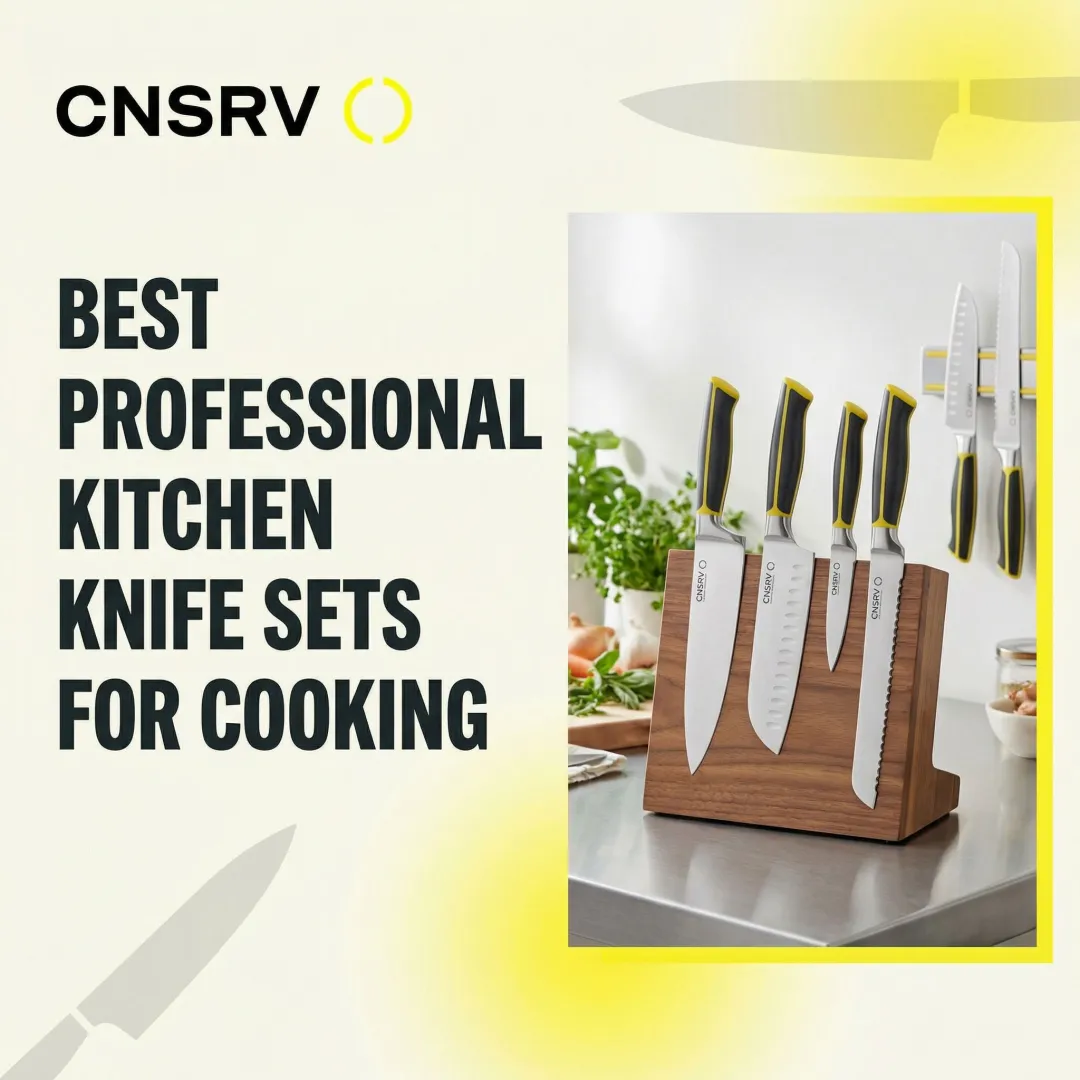
When Knife Block Sets Make Sense
That flexibility has trade-offs, though. Knife sets are appropriate for:
- Restaurant operators outfitting an entire kitchen where matched aesthetics and consistent steel matter
- Gifting where presentation and completeness are valued
- Those who prefer matched collections for visual consistency
What to look for in high-end sets:
- Consistency of steel and manufacturing across all included pieces (not mixing forged and stamped)
- Quality of included accessories (honing rod material, block construction)
- Realistic pricing (high-end sets cost $400-800+; mid-tier sets marketed as "professional" typically run $200-400)
How to Care for High-End Chef Knives
Essential Daily Care Rules
- Hand-wash only — dishwashers expose blades to high heat and harsh detergents that damage both handles and edges
- Dry immediately after washing to prevent rust and corrosion, especially important for carbon steel and high-carbon stainless
- Store on a magnetic strip or in a knife block — never loose in a drawer where blades contact other metal
- Hone before each use to realign the blade edge without removing steel
Honing vs. Sharpening: What's the Difference
Honing realigns the microscopic "teeth" of the edge without removing significant metal. Should be done frequently (daily for professional use). German knives use standard honing steels; Japanese knives require ceramic rods or fine whetstones to avoid damaging harder edges.
Sharpening removes steel to create a new edge. Required when honing no longer restores cutting performance (every 6-12 months depending on use). Professional sharpening services are the gold standard for annual maintenance. Japanese knives with harder steel are best sharpened by someone experienced with their specific bevel angles — Shun, for example, recommends a 6000-grit whetstone for touch-ups between professional sharpenings.

Angle preservation matters:
- Wüsthof/Zwilling: Maintain 14-15° per side
- Shun: Maintain 16° per side
- Miyabi: Maintain 9.5-12° per side
Frequently Asked Questions
What brand of knives do professional chefs use?
Professional chefs most commonly use Wüsthof, Zwilling J.A. Henckels, MAC, Shun, and Global, with Victorinox Fibrox favored by budget-conscious professionals. Preference typically comes down to whether the chef favors German (rocking chop) or Japanese (push-cut) technique.
Which knife is most commonly used in professional kitchens?
The 8-inch chef's knife is the universal standard in professional kitchens, used for the majority of prep tasks including chopping, slicing, and dicing. The gyuto (Japanese equivalent) is now standard in many fine dining environments where precision slicing is prioritized.
What is the difference between German and Japanese chef knives?
German knives use softer, thicker steel (HRC 56-58) suited for heavier work, rocking motions, and frequent honing. Japanese knives use harder, thinner steel (HRC 60-62) that holds a sharper edge longer but requires more careful handling and specialized sharpening technique to avoid chipping.
Should I buy individual knives or a knife set?
Professional chefs should start with three core knives (chef, paring, serrated) chosen for individual performance rather than brand matching. Knife sets make sense for outfitting full kitchens, gifting, or those who prefer a matched, curated collection with consistent aesthetics.
How long should high-end chef knives last?
Quality forged knives from reputable brands can last 25 years or more with proper care—including regular honing, professional sharpening once or twice annually, and correct storage. This longevity puts the per-year cost of ownership under $10 annually for premium knives.
What is the difference between forged and stamped knives?
Forged knives are shaped from a single piece of heated steel, producing better edge geometry, superior balance, and greater durability. Stamped knives are punched from a steel sheet, which makes them faster to produce and less expensive, but generally inferior in feel and longevity for professional use.