Introduction
Choosing the right industrial kitchen equipment isn't just about filling a space with appliances—it's one of the most consequential decisions commercial kitchen managers make. The wrong equipment leads to failed health inspections, inefficient workflows, and operational costs that drain profitability month after month.
Each equipment category carries its own health code implications, energy consumption patterns, and maintenance requirements. Every piece must satisfy regulatory standards while supporting efficient daily operations.
This guide breaks down what commercial kitchens actually need to know:
- Essential equipment categories and what drives selection decisions
- Health code requirements that directly affect inspections and compliance
- How to evaluate total cost of ownership, not just purchase price
- Overlooked cost drains — including water waste during food prep, which can cost thousands annually
TLDR
- Industrial kitchen equipment falls into five core categories: cooking, refrigeration, food prep, warewashing, and storage
- Prioritize NSF certification and energy ratings before price when selecting equipment
- Non-compliant equipment can result in fines, forced closures, and costly retrofits
- Many kitchens overspend on inefficient processes like running-water defrosting that can waste up to 1,000,000 gallons of water per year
- Preventive maintenance costs 25-30% less than reactive repairs and extends equipment lifespan by years
Essential Categories of Industrial Kitchen Equipment
The terms "industrial" and "commercial" kitchen equipment are used interchangeably in the food service industry. Both refer to heavy-duty, high-capacity equipment designed for professional environments, distinguishing them from residential-grade appliances that can't withstand the volume, temperature extremes, and continuous use of commercial operations.
Cooking Equipment
Commercial cooking equipment forms the operational core of most kitchens. The essential lineup includes ranges, ovens (convection, combi, and deck), fryers, griddles, broilers, and steamers. The right mix depends entirely on your menu type and daily volume—a high-volume burger concept has vastly different needs than a fine dining kitchen focused on plated entrees.
Cooking equipment accounts for 40% of total energy consumption in commercial kitchens. ENERGY STAR certified equipment can save approximately $4,000 annually in utility costs—a reduction that compounds across the equipment's lifespan.
Key efficiency gains by equipment type:
- Gas fryers improve from 35% to 50% efficiency with ENERGY STAR certification
- Electric steamers deliver 54% better efficiency than gas alternatives
- Gas griddles reach 38% efficiency with certified models, up from 18%
- Convection ovens increase from 44% to 49% efficiency

Refrigeration Equipment
Refrigeration failures represent one of the highest-risk failure points in commercial kitchens. A single breakdown can spoil $15,000 to $50,000 in perishable inventory within hours—triggering health code violations and cutting off menu items you can no longer serve.
Main refrigeration categories include:
- Reach-in refrigerators and freezers for daily access
- Walk-in coolers and freezers for bulk storage
- Undercounter units positioned at prep stations for quick access
- Blast chillers for rapid cooling compliance
Matching refrigeration capacity to your actual volume prevents spoilage and keeps you on the right side of health inspections. Refrigeration accounts for 15% of total kitchen energy use, and ENERGY STAR certified units run 20% more efficiently than standard models—a straightforward payback through lower utility bills.
Food Prep Equipment
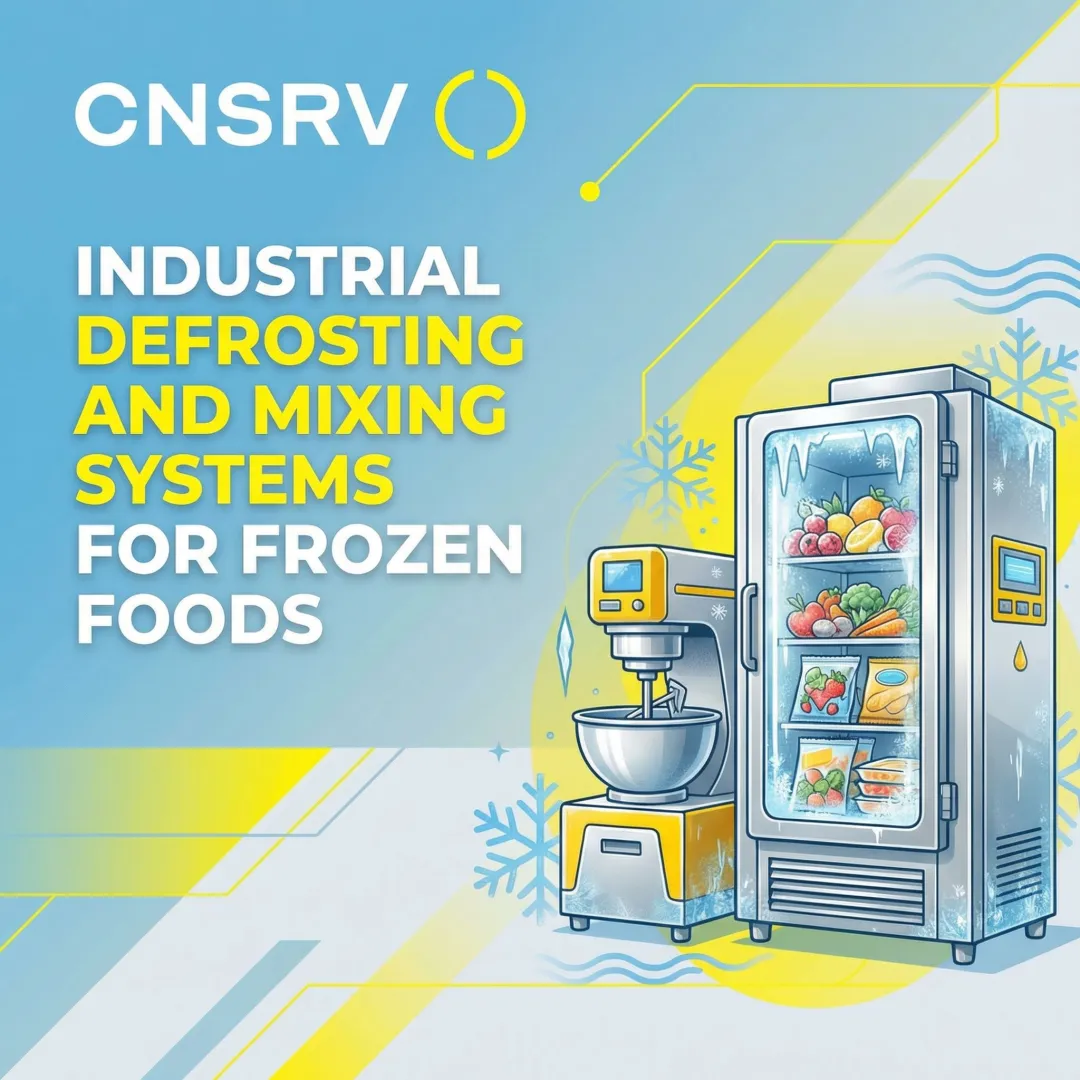
Food prep equipment directly affects throughput speed and food quality consistency. Essential prep tools include commercial slicers, food processors, mixers, prep tables, and defrosting systems.
Traditional FDA-compliant running-faucet defrosting can waste 660 gallons per day in a medium-sized kitchen—hundreds of thousands of gallons annually, with a water bill to match.
Modern closed-loop defrosting systems like the CNSRV DC:02 address this waste directly. The system uses 98% less water than running-faucet methods, defrosts food in half the time, and is NSF-listed for food contact under Standard 169. It requires zero installation, ships directly to your kitchen, and qualifies for water conservation rebates. The system has saved over 60 million gallons of water across its user base.
Warewashing & Storage Equipment
Efficient warewashing and organized storage are essential for food safety and smooth service flow. Commercial dishwashers come in several configurations:
- Undercounter units for smaller operations
- Door-type machines for medium volume
- Conveyor systems for high-volume operations
ENERGY STAR Version 3.0 sets strict water and energy limits. Single tank conveyor machines must use ≤0.70 gallons per rack, while multi-tank systems must stay ≤0.54 gallons per rack.
Storage systems—including drying racks, shelving units, and dry storage areas—must meet NSF standards for cleanability and material safety. Proper storage prevents cross-contamination and supports efficient inventory rotation.
How to Choose the Right Industrial Kitchen Equipment
Buying industrial kitchen equipment is a long-term capital commitment. The wrong choice leads to underperformance, frequent repairs, regulatory risk, and replacement costs that far exceed any initial savings from going cheap.
Assess Your Kitchen's Volume and Menu Needs First
Equipment selection should be driven by projected covers per day, menu complexity, and food types. A 200-seat casual dining restaurant serving burgers and fries needs different cooking capacity than a 40-seat fine dining establishment with complex plated dishes.
That difference in format and scale directly shapes every equipment decision. Calculate your peak-hour volume and work backward — if you serve 150 covers during a 2-hour dinner rush, your cooking equipment must handle that throughput without creating bottlenecks that slow ticket times.
Prioritize NSF Certification and Local Health Code Compliance
NSF certification signals that equipment is safe for food contact, cleanable to sanitary standards, and approved for regulated food service environments. Most health departments require NSF or equivalent ANSI-accredited certification during inspections.
Consequences of non-certified equipment:
- California: Fines ranging from $50 to $2,500 per violation, potential facility closure
- Texas: Misdemeanor violations with fines up to $2,000 per day
- Forced equipment removal and costly retrofits
Calculate Total Cost of Ownership Before You Buy
Total cost of ownership includes purchase price, installation costs, energy consumption, water usage, and maintenance costs over a 5-10 year lifespan. Cheaper upfront equipment often proves more expensive long-term.
Calculate TCO using this framework:
- Purchase price + installation
- Annual energy costs × equipment lifespan
- Annual water costs × equipment lifespan
- Estimated maintenance and repair costs
- Replacement timeline based on expected lifespan
Run the numbers before committing. A $3,000 ENERGY STAR fryer that saves $460 annually will recover the price difference in roughly one year and save $4,600 over its lifetime compared to a $2,500 standard-efficiency model. The certified unit is the stronger investment.

New vs. Used Equipment: Know the Tradeoffs
Used equipment can reduce upfront costs by roughly 50%—for example, exhaust hoods selling for $6,500 versus $13,000 new. However, tradeoffs include hidden repair costs, outdated energy ratings, and potential lack of NSF recertification.
When new equipment makes sense:
- Mission-critical items (refrigeration, fryers)
- Equipment with significant energy efficiency improvements
- When warranties and manufacturer support matter
- Opening a new location requiring full compliance
Used equipment works well for:
- Non-critical items with simple mechanics
- Budget-constrained startups
- Temporary or seasonal operations
- Items with minimal energy consumption differences
Health Code Compliance and Safety Standards for Commercial Kitchens
Equipment selection and kitchen design must satisfy local health department requirements, NSF standards, and fire codes. Non-compliance results in failed inspections, fines, or forced closure.
Key Compliance Requirements to Know
Major compliance checkpoints include:
- NSF certification on food-contact surfaces (NSF/ANSI 2 for food equipment)
- Proper ventilation meeting NFPA 96 standards for hood systems and exhaust ratings
- Handwashing station placement and accessibility
- Refrigeration temperature logs and monitoring systems
- Warewashing chemical dispensing and sanitization verification
Requirements vary by state and municipality. Full-service restaurants showed a 95% out-of-compliance rate for improper holding in FDA risk factor studies, highlighting how common violations occur even in established operations.
Consult your local health department's equipment approval list before purchasing. Keep documentation of all NSF certifications on-site for inspections.
Working with Equipment That Already Meets Standards
Choosing equipment pre-certified to NSF and ANSI standards from the outset reduces the risk of costly retrofits or rejected inspections. That risk compounds quickly when opening a new location or mid-renovation — two moments when inspectors pay closest attention.
NSF/ANSI 2 certification confirms that equipment is non-toxic, corrosion-resistant, and built for cleanability — meaning smooth corners, no hidden crevices, and accessible fasteners that don't trap bacteria. This applies to every food-contact surface in the kitchen, including defrosting equipment. CNSRV's DC:02, for example, carries an NSF listing for food contact, which satisfies this requirement without additional documentation work on your end.
Reducing Operational Costs Through Smarter Equipment Choices
The most successful commercial kitchen operators view equipment as a cost-reduction lever, not just a capital expense. They continuously audit where waste occurs and target high-impact improvements.
Audit Energy and Water Consumption First
Food service buildings consume approximately 263,000 Btu per square foot annually—nearly four times the commercial average. A 5,800 square foot full-service restaurant can face annual electricity bills around $30,831. Water adds up too—at $6.13 per 1,000 gallons on average. Cut energy costs by just 20% and profits can jump by as much as one-third.
Target Water Waste in Food Prep Operations
One of the most overlooked sources of water waste in commercial kitchens is the defrosting process. Traditional FDA-compliant running faucet methods can use 315 to 661 gallons per defrost cycle. Multiplied across dozens of daily cycles, this adds up to massive water bills—some kitchens waste between 114,390 and 240,900 gallons annually on defrosting alone.
The CNSRV DC:02 is a closed-loop defrosting system built to eliminate that waste. Key specs:
- Uses 98% less water than running faucet methods
- Defrosts food in half the time
- NSF-listed under Standard 169 for food contact
- Zero installation — ships directly to your kitchen and qualifies for water conservation rebates
Across its user base, the system has saved over 60 million gallons of water. It's priced so operators pay less each month than they save on their water bill — Nobu Malibu reported saving over $2,000 in their first month.
Leverage Rebates and Efficiency Programs
Utility rebates and efficiency incentives can put hundreds to thousands of dollars back into your budget. Programs vary by state, but available options include:
Available rebate programs:
- California's CalWEP program offers direct distribution discounts; Metropolitan Water District pays $800 per qualifying defrosting unit
- Washington/Idaho (Avista): up to $3,400 for ovens, $1,500 for fryers
- Florida (Tampa Bay Water): custom rebate programs for commercial kitchens
- Oregon (Portland Water Bureau): customizable incentive programs
- ENERGY STAR CFS Incentive Finder: $20–$5,000 for ovens, $20–$1,900 for fryers, $25–$2,700 for dishwashers
Maintaining Industrial Kitchen Equipment
Unplanned equipment failure during peak service is one of the highest-cost events a commercial kitchen can face—both in lost revenue and emergency repair fees. A single equipment failure can cost between $2,000 and $5,000 in immediate lost sales and spoiled inventory.
Build a Preventive Maintenance Schedule
Preventive maintenance costs 25-30% less than reactive maintenance due to emergency labor rates and rush parts shipping. It can also deliver a 400% ROI by extending asset life and reducing energy use by 10-20%.
Basic preventive maintenance structure:
- Daily: Cleaning protocols for cooking and prep equipment, visual checks
- Weekly: Deep cleans of cooking surfaces, filters, and high-touch areas
- Monthly: Inspections of refrigeration seals and compressors, warewashing chemical levels
- Annually: Professional servicing for major equipment, hood system cleaning per NFPA 96

Always follow manufacturers' manuals for specific intervals. Regular maintenance can double equipment life—a convection oven with a 7-year life can last 15 years with preventive maintenance, saving approximately $1,250 annually.
Train Staff on Proper Equipment Use and Cleaning
The Foodservice Equipment Distributors Association reports that 55% of equipment failures are attributed to improper maintenance—most of which trace back to staff behavior, not mechanical defects.
Onboarding and posted SOPs for each piece of equipment are your first line of defense. Each SOP should cover:
- Correct operating procedures and load limits
- Daily and weekly cleaning steps
- Common misuse scenarios to avoid
- Basic troubleshooting before calling for service
Know When to Repair vs. Replace
The industry standard "50% Rule" offers a clear decision point: if a repair costs more than 50% of the replacement cost, replacement is usually the better long-term investment. Newer equipment typically delivers better energy and water efficiency ratings, lowering ongoing operating costs.
Expected equipment lifespans:
- Gas ranges: 18-20 years
- Walk-in coolers: 15+ years
- Refrigeration units: 10-15 years
- Dishwashers: 8-12 years
- Deep fryers: up to 20 years
Frequently Asked Questions
What equipment is required in an industrial kitchen?
Every commercial kitchen requires equipment across five core categories: commercial cooking equipment (ranges, ovens, fryers), refrigeration (reach-ins, walk-ins), food prep tools and systems (slicers, mixers, defrosting equipment), warewashing (dishwashers, sinks), and storage (shelving, racks). Specific requirements vary by menu type and local health codes.
How much does it cost to fully equip a commercial kitchen?
Costs vary widely based on kitchen size, menu complexity, and whether equipment is new or used. Industry data shows outfitting a commercial kitchen with new equipment typically ranges from $40,000 to $200,000, with new restaurants spending an average of $115,655 on bar and foodservice equipment.
What does NSF certified mean for kitchen equipment?
NSF certification confirms equipment meets public health and safety standards for food contact, cleanability, and material safety — covering non-toxicity, corrosion resistance, and sanitary design. Most health departments require NSF or equivalent ANSI-accredited certification for commercial operations. CNSRV's DC:02 defrosting system carries NSF listing for food contact, meeting these standards out of the box.
Is it better to buy new or used commercial kitchen equipment?
New equipment offers warranties, current efficiency standards, and regulatory compliance certainty. Used equipment lowers upfront cost (often by 50%) but may carry hidden repair costs, outdated energy ratings, or lack NSF recertification. Factor in total cost of ownership — energy consumption and maintenance over 5-10 years — before deciding.
How can commercial kitchens reduce equipment operating costs?
Several targeted actions can meaningfully cut operating costs:
- Run energy and water audits to pinpoint waste
- Switch to ENERGY STAR-rated appliances, which can save thousands annually
- Replace running-faucet defrosting with systems like the CNSRV DC:02, which uses 98% less water than traditional methods
- Apply for utility rebates and efficiency incentive programs
Preventive maintenance also reduces costs 25-30% compared to reactive repairs.
How often should industrial kitchen equipment be serviced?
Follow a tiered schedule: daily and weekly cleaning by staff, monthly visual inspections of seals and mechanical components, and annual professional servicing for major equipment. Intervals should ultimately be guided by each manufacturer's maintenance specifications, which account for usage patterns and equipment complexity.